When Mindshare Becomes a Tradable Asset
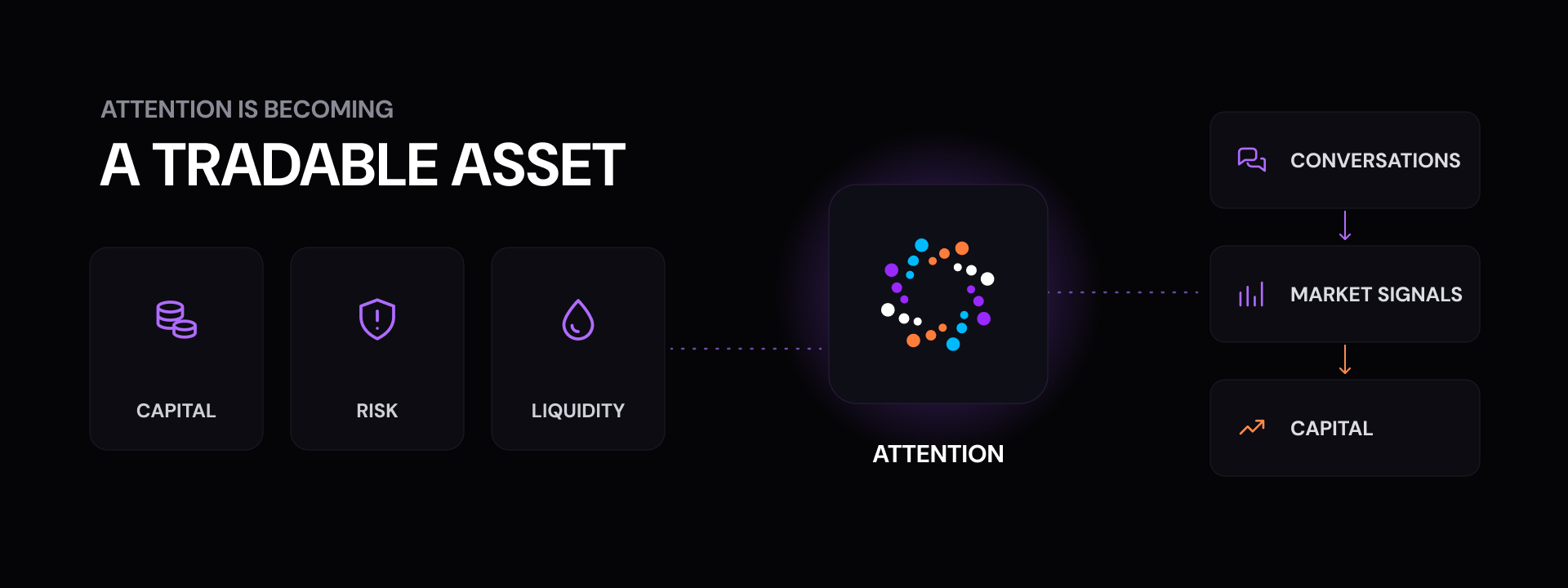
Markets used to reward whoever had information first.
Today, information is abundant. The real advantage lies in identifying which conversations are shaping narratives, attracting conviction, and influencing capital allocation before the broader market notices. This shift sits at the center of attention markets, where mindshare is evolving from a cultural signal into a tradable market input.
The effects are already visible across modern markets. Entire sectors emerge around narratives. Memecoins attract billions in liquidity. Prediction markets respond to shifts in public sentiment before traditional media catches up. Communities form around ideas long before institutional capital arrives.
The common thread across these developments is attention.
Yet not all attention carries the same significance. Attention may create awareness, but awareness alone rarely moves markets. Mindshare emerges when a topic sustains discussion and captures a growing share of attention within a community. Conviction follows when participants begin acting on that narrative rather than simply talking about it. Many signals attract attention and quickly fade, while others progress through these stages and ultimately influence market behavior.
The analytical challenge is understanding where a signal sits within that progression. Historically, these shifts were difficult to observe. Investors relied on headlines, analyst commentary, and consumer surveys as indirect proxies for public interest, making it difficult to distinguish fleeting attention from signals capable of influencing market behavior.
That distinction is beginning to disappear.
Platforms such as Kaito and Polymarket represent two different expressions of the same structural shift. One measures collective attention across social networks. The other converts collective belief into market prices. Together, they point toward a broader trend: attention is becoming observable, measurable, and increasingly financialized.
Kaito shows that attention can be indexed. Polymarket shows that belief can be priced. The next challenge is understanding which signals are capable of becoming conviction, and which are simply noise.
The market is no longer just reacting to attention. It is beginning to price it.
The Emergence of Attention Markets
Every market is ultimately a mechanism for aggregating information, but information itself has changed. Increasingly, the most valuable signals do not originate from quarterly reports or formal disclosures. They originate from conversations.
A narrative begins on X. A creator publishes a video on TikTok. A discussion gains momentum on Telegram or Discord. Researchers begin investigating the same idea. Builders start contributing to it. Traders position around it. Capital follows. What begins as a conversation eventually becomes a market event.

This process has become so common that it is easy to overlook how significant it is. Entire categories of crypto assets now derive value from collective attention. Some achieve massive valuations before generating meaningful revenue. Others attract liquidity because a narrative spreads faster than the market can fully price it. The path from conversation to capital has become dramatically shorter than it was only a few years ago.
This is what makes attention markets important.
The goal is not simply to measure popularity. The goal is to identify emerging market behavior before it becomes obvious.
The most useful signals rarely appear when everyone is already paying attention. They emerge earlier, when attention and market activity have not yet fully aligned.
The Mismatch
One of the most consistent patterns in markets is that attention often moves before price.
A topic begins appearing across multiple communities. Researchers start discussing it. Influential accounts independently arrive at similar conclusions. Engagement increases. The narrative expands. Yet market activity remains relatively muted.
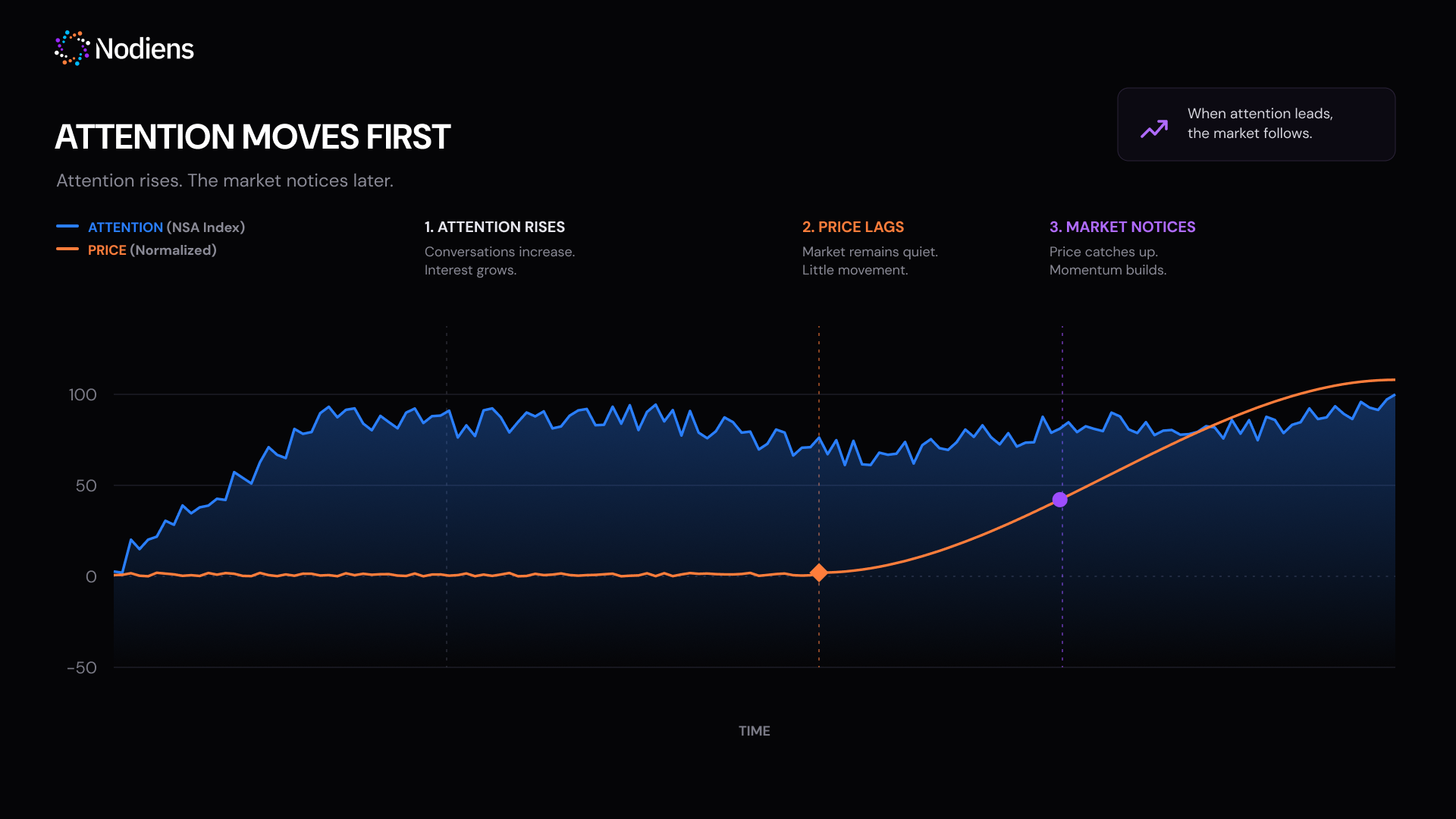
At first glance, nothing appears to be happening.
In reality, the market is beginning to form around a new idea.
This is where attention becomes valuable as a signal. Not because attention itself predicts outcomes, but because shifts in collective attention often reveal changes in market behavior before those changes become visible elsewhere. By the time price fully reflects a narrative, the conversation that created it has usually been underway for some time.
The opportunity exists inside the gap between those two events.
Attention rises. The market notices later.
Why Attention Volume Is Not Enough
The emergence of attention markets creates a new challenge. Measuring attention is relatively easy. Understanding it is much harder.
Most attention systems focus on visibility. They count posts, mentions, views, impressions, and engagement. These metrics provide a useful starting point, but they share a common weakness: they assume all attention carries equal weight.

Markets do not work that way. A thousand engaged participants can matter more than a hundred thousand passive impressions. A small group of researchers, builders, and long-term community members can generate more durable market impact than a viral campaign that dominates social feeds for a week.
The reason is simple: not all attention is created equal. Some attention is organic. Some is purchased. Some emerges from genuine conviction. Some emerges from coordinated amplification. From a purely quantitative perspective, these situations can look remarkably similar. From a market perspective, they are completely different.
A protocol attracting sustained interest from builders and researchers represents a different signal than a protocol experiencing a temporary surge in engagement. A community that continues strengthening after the initial attention spike fades tells a different story than a community that disappears as soon as incentives decline.
As attention becomes increasingly important to capital allocation, the market does not simply need to know where attention exists. It needs to understand whether that attention reflects genuine conviction or temporary noise. Visibility is easy to measure. Conviction is not.
Attention Markets Need A Quality Layer
Every important market eventually develops infrastructure to separate signal from noise. Equities developed research desks. Credit markets developed rating agencies. On-chain markets developed analytics platforms capable of interpreting blockchain activity. As attention becomes a market signal in its own right, attention markets will require something similar.
The challenge is that raw social data is inherently noisy. Bots generate engagement. Coordinated campaigns manufacture momentum. Incentives can attract activity that disappears as quickly as it arrives. A surge in attention may reflect growing conviction, but it may also reflect artificial amplification. Without additional context, the difference can be difficult to identify.
The next generation of market intelligence will focus less on attention volume and more on attention quality. The goal is not simply to identify where conversations are happening, but to understand whether that attention is organic, whether communities are strengthening, and whether market behavior is beginning to confirm what social activity is suggesting.
Measuring attention is relatively easy. Understanding its quality is far more difficult.
The future of attention analysis is not measuring how loud a conversation becomes. It is understanding why it became loud in the first place.
The Edge Hidden in the Noise
Nodiens is built to read what sits beneath the noise. It asks what kind of attention it is: whether it comes from a strengthening community or a temporary campaign, whether sentiment reflects early conviction or late-stage euphoria, whether engagement looks organic or manufactured, and whether the market is beginning to confirm the narrative.
Six proprietary indices isolate it.
NSA, Nodiens Spike Attention Index: detects unusual attention surges before they become obvious across the broader market.
NSS, Nodiens Sentiment Strength Index: reads the emotional force behind the conversation, conviction, doubt, optimism, fear, or hype.
NCS, Nodiens Community Strength Index: shows whether a community is truly active, durable, and engaged, or only temporarily loud.
NCR, Nodiens Community Risk Index: measures organic engagement from bots, coordinated amplification, fake activity, and low-quality noise.
NSI, Nodiens Sentiment Intelligence Index: connects sentiment with attention intensity to show whether conviction is sustained or temporary.
NMI, Nodiens Market Intelligence Index: adds the market layer, measuring whether price movement is backed by real trading activity, volume, and market participation.
The edge appears when these signals align.

That is when attention stops being noise and starts becoming conviction.
And conviction is what markets begin to price.
What Comes Next
The first generation of attention markets focused on visibility. The next generation will focus on conviction.

As mindshare becomes measurable, tradable, and increasingly financialized, the value of attention alone begins to diminish. Visibility is becoming abundant. The real advantage lies in identifying which signals are progressing from attention to conviction before they are fully reflected in market behavior. What remains scarce is the ability to distinguish genuine conviction from manufactured attention, durable communities from temporary engagement, and meaningful signals from noise.
The market has already learned how to measure attention. The harder challenge is understanding its quality. As attention becomes a financial primitive, that distinction may become one of the defining advantages of the next market cycle.