How to Spot a Fake Crypto Pump
TL;DR
A token jumps 200% in a day, influencers start promoting it, and social media fills with bullish predictions. Before buying in, ask what is actually driving the rally. Is attention growing alongside genuine community engagement and market participation, or is the price running ahead of the evidence? Cases like RAVE and CYBERLEEK show why a dramatic price surge deserves closer scrutiny. By examining attention, community health, sentiment, and market activity through Nodiens, traders can identify warning signs and make more informed decisions before chasing the next pump.
What a Fake Crypto Pump Looks Like
A token starts trending. Its price shoots up. Everyone on social media seems convinced it is the next big thing. But how can you tell whether the rally has real support or is running on hype?
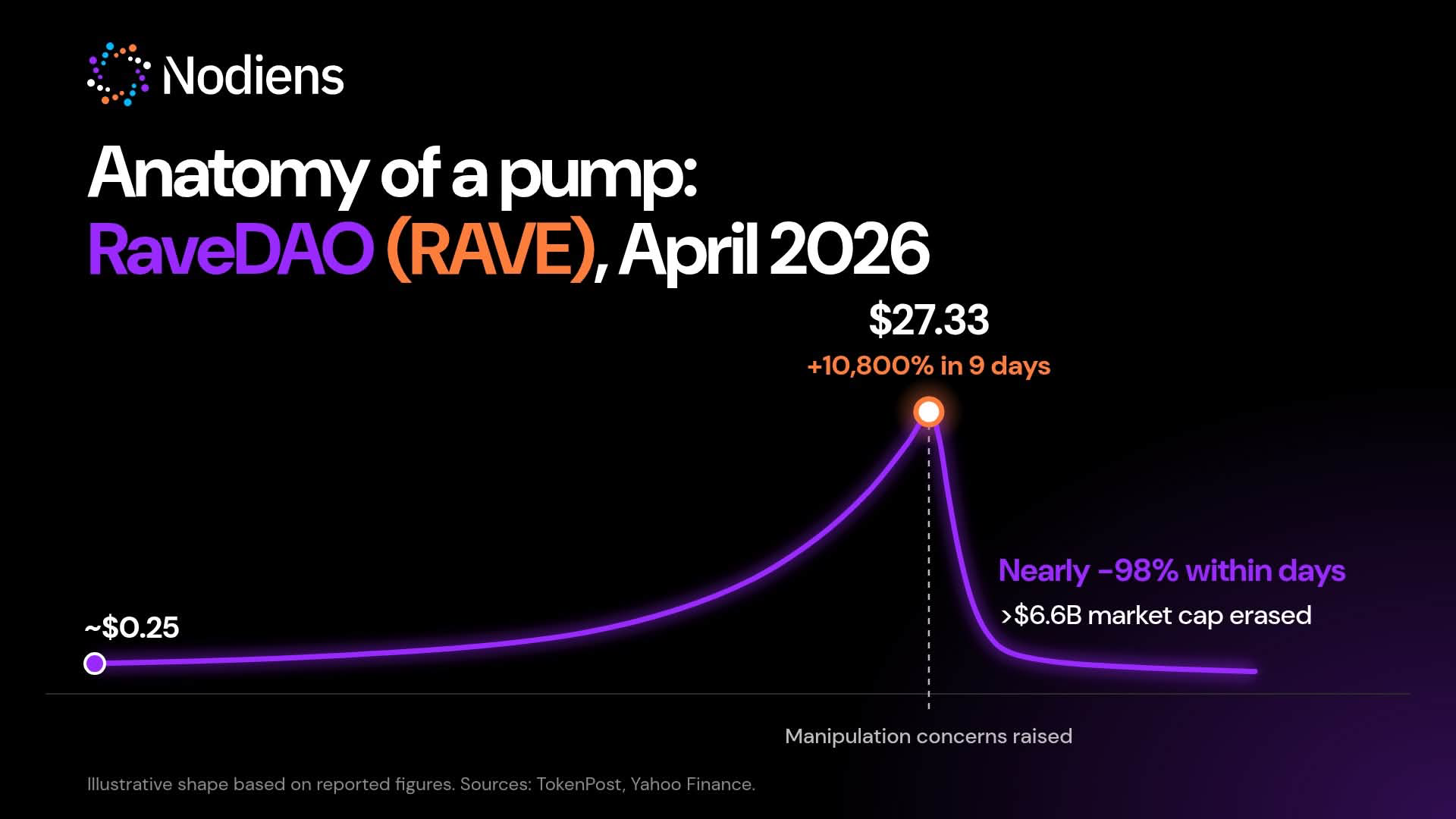
A fake crypto pump occurs when hype or coordinated buying artificially drives up a token’s price, potentially attracting buyers before earlier holders sell. RAVE, the RaveDAO token, illustrates why a dramatic rally deserves closer scrutiny. According to TokenPost, RAVE surged roughly 10,800% in nine days in April 2026, from around $0.25 to $27.33. On-chain investigator ZachXBT subsequently raised concerns about concentrated token holdings and called on exchanges to investigate possible manipulation. RAVE later suffered a sharp crash, although RaveDAO denied involvement in the price action. The episode raised questions about whether the rally was supported by sustainable demand.
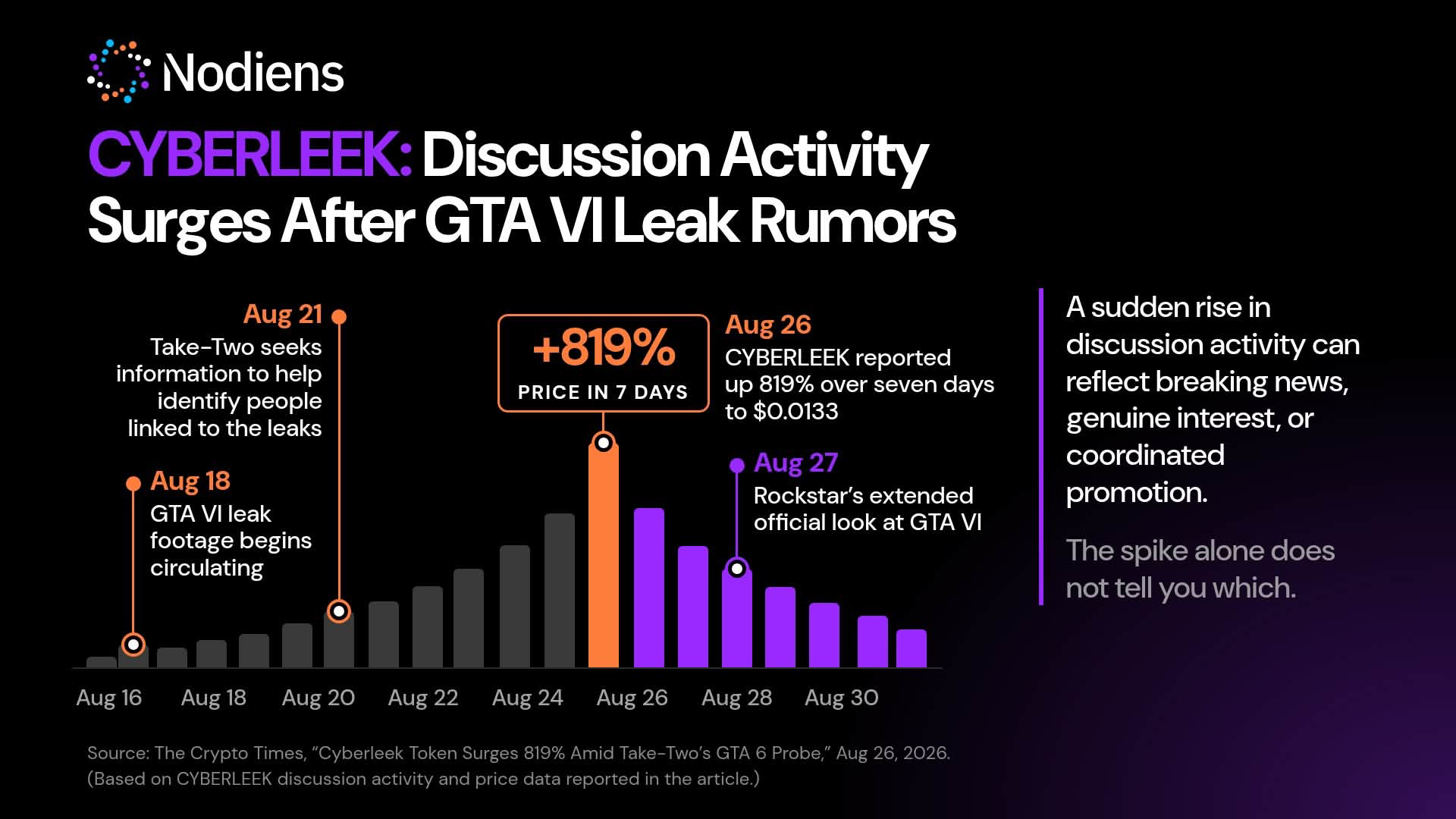
A more recent example is CYBERLEEK, a Solana-based token that surged amid attention surrounding alleged Grand Theft Auto VI leaks in August 2026. According to The Crypto Times, the token gained more than 800% in seven days. Its subsequent volatility illustrates how quickly a rally tied to a viral narrative can reverse when speculative momentum shifts. However, neither a sharp price increase nor a sudden crash alone proves manipulation.
For traders, the challenge is distinguishing genuine interest from hype-driven promotion. The most useful approach is to examine what triggered the attention, whether community activity appears credible, whether sentiment reflects growing conviction, and whether market participation supports the price movement. These signals provide a more complete picture of a rally than price action alone.
This shows why a rapidly rising price and widespread attention do not always reflect genuine market support. Below are five warning signs to check before buying into a sudden rally, and how Nodiens' indices can help you assess each one. No single signal proves manipulation, but when several appear together, the rally deserves closer scrutiny.
1. Watch for an Unusual Spike in Attention
A sudden spike in mentions can make a token appear more popular than usual, but the key is understanding what is driving that attention. A surge following a major announcement may reflect genuine interest, while one fueled by repetitive messaging or coordinated promotion may create an inflated impression of community demand. The challenge is that a spike alone does not reveal which explanation is more likely.
CYBERLEEK illustrates why this distinction matters. Its reported 819% price increase over seven days coincided with growing attention around the GTA VI leak saga. The price movement demonstrates how a viral narrative can draw market interest, but it does not establish whether discussion around the token grew organically or was deliberately amplified. To assess that, we need to look beyond the price and examine how attention changes relative to the token’s usual discussion patterns.
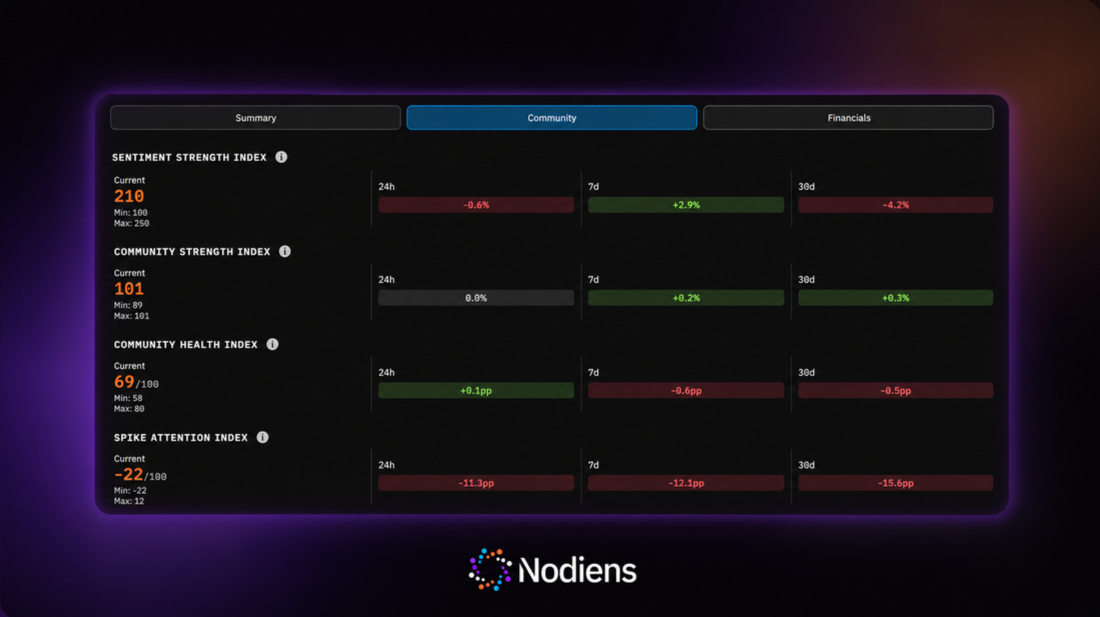
This is where the Nodiens Spike Attention (NSA) Index comes in. NSA identifies unusual increases in discussion activity compared with an asset’s normal baseline, helping flag when a token suddenly attracts more attention than usual. It does not determine whether that attention is organic or coordinated on its own, but it highlights spikes worth investigating alongside community health, sentiment, and market activity.
When assessing a sudden pump, consider:
- Is discussion increasing much faster than usual?
- Did the attention spike coincide with identifiable news or an emerging narrative?
- Is the promotion coming from influencers or channels that may not disclose their own holdings?
- Does the increase persist, or does activity quickly return to normal?
- Is the growing attention accompanied by changes in sentiment and market activity?
An attention spike is not evidence of manipulation by itself. It identifies a change in the conversation that needs to be interpreted alongside other signals.
2. Check Whether the Community Activity Looks Genuine
A token can appear widely supported even when its engagement comes from a small group of highly active accounts. Repetitive posts, fake engagement, and coordinated promotion can create the illusion of a larger, more active community.
The Nodiens Community Health (NCH) examines potentially suspicious activity, including spam, repetitive messaging, coordinated communication, and abnormal user behavior. Meanwhile, the Community Strength (NCS) Index assesses community expansion, engagement depth, participation quality, holder retention, and external trust signals to help evaluate whether a community is building lasting engagement or experiencing a temporary surge.
Together, these indices help traders tell the difference between noisy activity and healthy, sustained participation, offering useful context on whether the community behind a sudden pump is as strong as it appears.
It is also worth checking who actually holds the token. A large, active community means little if most of the supply sits in a handful of wallets. In the RAVE case, on-chain analysis pointed to roughly 95% of the supply sitting in just nine wallets linked to the project, the kind of concentration that can allow a few holders to move the price and sell into new demand.
3. Compare Attention With Sentiment
Another warning sign emerges when the amount of discussion and the tone of that discussion begin to tell different stories.
An asset may attract more attention without becoming more convincing to the people discussing it. Traders may react to volatility, express uncertainty, question a price increase, or debate whether a rally can continue. A rising number of mentions does not necessarily indicate growing bullish conviction.
The Nodiens Sentiment Strength (NSS) Index tracks the emotional tone and conviction expressed within a crypto asset’s community. It helps traders assess whether sentiment is becoming more optimistic, weakening, or shifting toward uncertainty.
The Nodiens Sentiment Intelligence (NSI) Index brings attention intensity and community mood together, providing additional context for understanding how these signals develop over time. Scored from −100 to +100, it shows at a glance whether community conviction is bullish, bearish, or mixed.
Consider a token that suddenly attracts widespread discussion. Attention rises sharply, but sentiment becomes less stable or begins to weaken. This divergence suggests that the increase in visibility is not being matched by stronger community conviction.
For a more complete assessment, examine:
- Whether sentiment strengthens as attention increases.
- Whether bullish discussion persists beyond the initial price spike.
- Whether changes in sentiment coincide with news or broader market developments.
- Whether attention remains elevated even as community conviction weakens.
The useful signal is not simply positive sentiment. It is how sentiment changes relative to attention and whether that relationship persists.
4. Check Whether Market Activity Supports the Price Move
Rising prices and bullish social media activity do not necessarily mean a rally has strong market support. Traders also need to examine whether trading activity can sustain the price move, rather than relying on price increases alone.
The Nodiens Market Intelligence (NMI) Index examines the strength of market pressure behind price movements in relation to trading activity. It helps traders assess whether a rally appears supported, overheated, or lacking meaningful participation.
Consider a token whose price climbs rapidly alongside a surge in trading volume. At first glance, the rally may look strong. However, if the market has limited liquidity, even a relatively small wave of selling can push the price down sharply. High trading volume does not necessarily mean there is enough market depth to absorb that selling pressure without significant slippage.
This is why traders need to look beyond price increases and assess whether market activity supports the move. NMI helps provide that context, although supportive signals cannot guarantee further gains.
A rising price gets attention. What supports it is what deserves yours.
5. The Nodiens Confirmation Gap: When Attention Outruns Conviction
A token's price is surging, social media is buzzing, and traders are rushing to get in. But a rally can look stronger than it really is when attention grows faster than genuine market participation. The key is to examine multiple signals together rather than relying on price momentum alone.
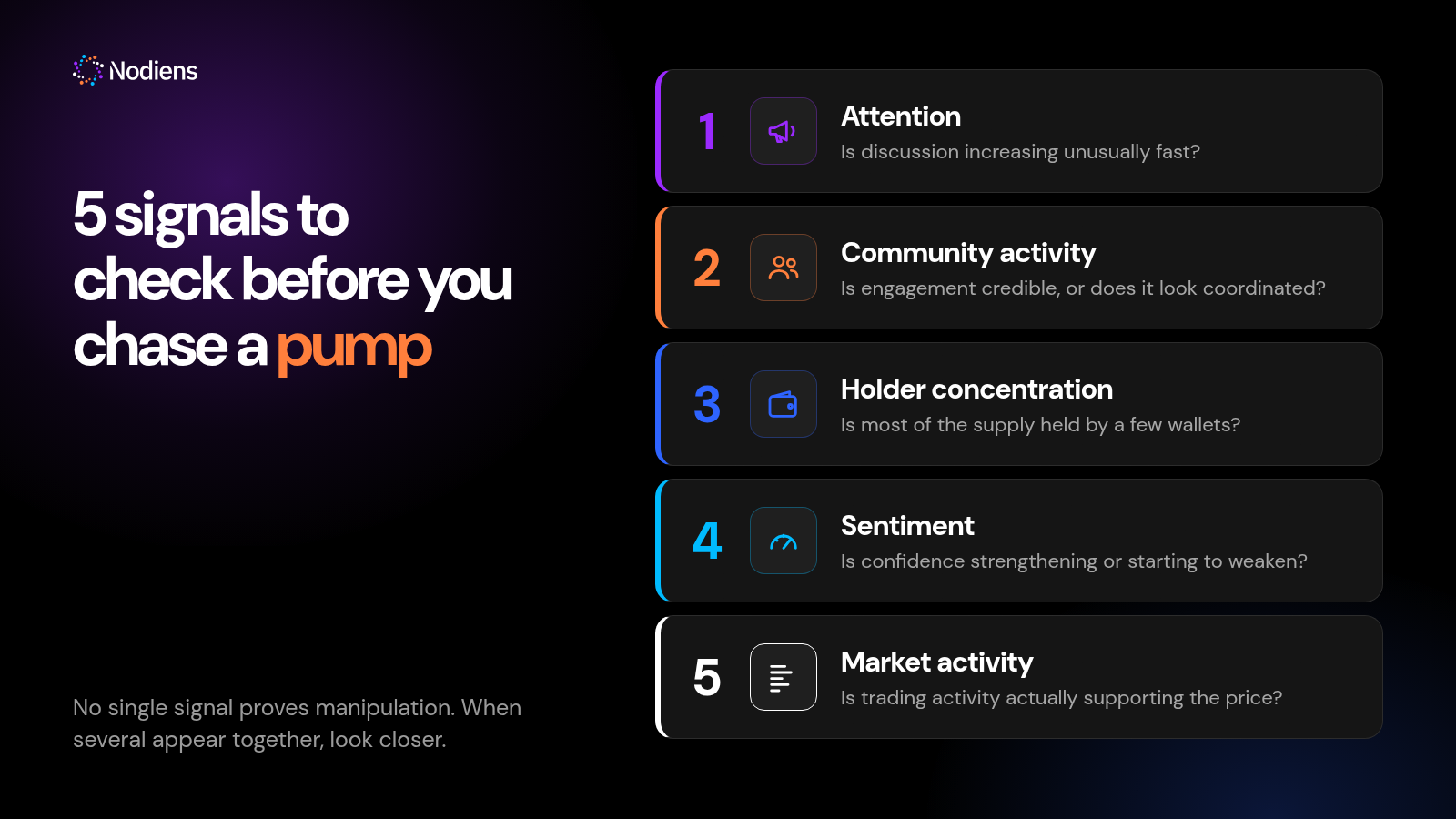
Before buying into a fast-moving rally, consider these five signals:
- Attention: Is discussion increasing unusually fast?
- Community activity: Are engagement patterns credible, or do they show signs of suspicious coordination?
- Holder concentration: Is most of the supply held by a small number of wallets?
- Sentiment: Is confidence strengthening or beginning to weaken?
- Market activity: Is trading activity supporting the price movement?
Nodiens brings attention, sentiment, community health, community strength, and market activity into one research environment, helping traders examine how these signals interact. No single indicator can predict a reversal or prove manipulation, but their relationships can reveal when a rally deserves closer scrutiny.
What Different Signal Combinations Actually Mean
Individual indicators provide only part of the picture. The more useful insights emerge when signals are compared and begin to diverge.
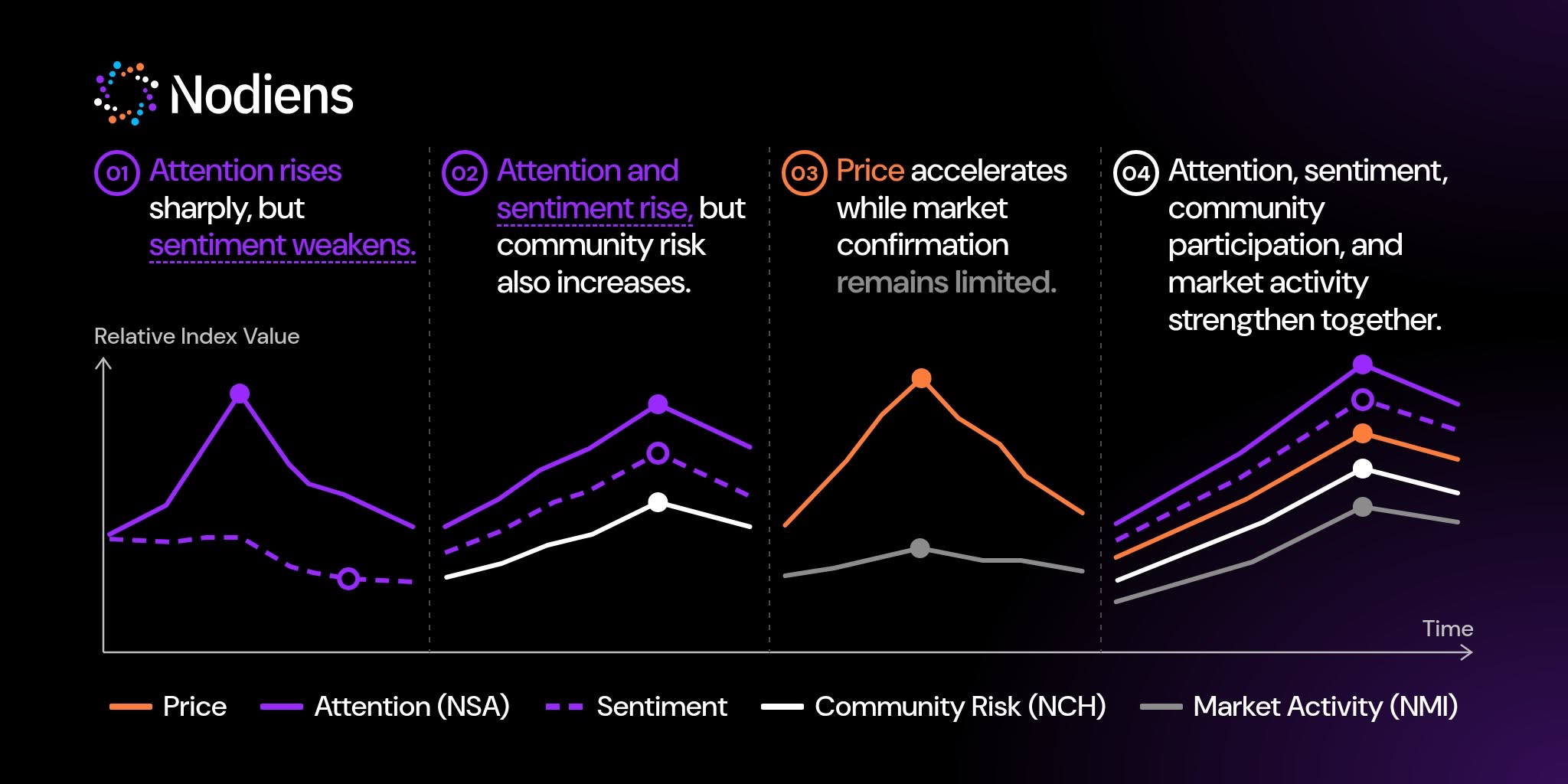
- Attention rises sharply, but sentiment weakens: More people are discussing the token, but community conviction is not keeping pace. The spike may reflect controversy, uncertainty, or short-lived speculation rather than growing confidence.
- Attention and sentiment rise, but community risk also increases: The conversation appears increasingly bullish, yet suspicious engagement or coordinated messaging may be contributing to the excitement. Positive sentiment alone does not establish that the interest is organic.
- Price accelerates while market confirmation remains limited: The token is climbing, but trading activity may not provide convincing support for the move. Thin liquidity can make prices more vulnerable to sharp swings in either direction.
- Attention, sentiment, community participation, and market activity strengthen together: This presents a more consistent picture of participation behind the rally. It still does not guarantee that the price will continue rising, but it provides a different context from a move driven primarily by hype.
These combinations are signals to investigate rather than automatic verdicts, as their significance depends on the asset, timeframe, available data, and wider market conditions. The goal is not to label every pump as fake, but to identify gaps between what a token’s price suggests and what its underlying signals actually support.
Look Beyond the Pump With Nodiens
As a token’s price climbs and more traders rush to get in, it’s easy to get caught up in the excitement. Yet a rally that attracts attention isn’t necessarily one with lasting support. Before buying in, take a few steps to understand what is driving the move.
A Practical Workflow for Investigating a Pump
- Discover the asset. Find the token you want to investigate in Nodiens and open its available market and social signals.
- Find the catalyst. Check the Market Feed for news and social discussions that may explain the sudden increase in attention. Look for a clear catalyst, and consider whether the discussion reflects genuine interest, controversy, or speculative hype.
- Test community conviction. In Coin Insights, compare attention, sentiment, and community health. Is sentiment keeping pace with rising attention? Does community activity appear credible, or are suspicious engagement patterns emerging?
- Check market context. Compare social signals with available market indicators to assess whether trading activity appears to support the price move. Look for divergences between rising attention, sentiment, and market activity rather than assuming they always move together.
- Validate externally. Use blockchain explorers and market-data tools to investigate wallet concentration, token ownership, exchange transfers, and pool-level liquidity. These details require separate verification and cannot be established by social signals alone.
Nodiens brings attention, sentiment, community behavior, and available market signals into one view, helping traders identify patterns worth investigating before acting on hype. These signals do not prove manipulation or guarantee future price movements, but they can help you make a more informed assessment.
Explore Nodiens and make your next move with more than just FOMO.
This article is for informational purposes only and does not constitute financial advice.
Frequently Asked Questions
- What is a fake crypto pump?
A fake crypto pump occurs when hype or coordinated buying artificially drives up a token’s price, potentially attracting buyers before earlier holders sell.
- What are the early warning signs of a pump-and-dump?
Watch for sudden spikes in attention, repetitive or suspicious community engagement, weakening sentiment, and concentrated token holdings. A sharp price increase followed by heavy selling can also warrant scrutiny. No single sign proves a pump-and-dump, so assess multiple sign
- Can positive sentiment coexist with manipulation?
Yes. Coordinated promotion, fake engagement, or repetitive messaging can make a token’s community appear more enthusiastic than it really is. Positive sentiment alone does not prove that interest is organic, so examine it alongside community health, attention patterns, and market activities together.
- Does high social attention mean a token is bullish?
Not necessarily. Attention can increase without stronger demand or community conviction, so it should be assessed alongside sentiment and community health.
- What does the Nodiens Community Health measure?
The Nodiens Community Health (NCH) examines potentially suspicious activity, including spam, repetitive messaging, fake engagement, coordinated communication, and abnormal user behavior.
- What is the Nodiens Spike Attention Index?
The Nodiens Spike Attention (NSA) Index identifies unusual increases in discussion activity compared with an asset’s normal pattern. It highlights changes in attention but does not determine whether the cause is legitimate or manipulative.
- What is the Nodiens Community Strength Index?
The Nodiens Community Strength (NCS) Index assesses community expansion, engagement depth, participation quality, holder retention, and external trust signals to help evaluate the strength and resilience of a community.
- Can Nodiens confirm that a crypto pump is manipulated?
No. Nodiens indices help identify unusual patterns in community behavior and sentiment, but they cannot independently prove manipulation or guarantee future price movements.