What Traders Should Track Beyond Price
Introduction
NFA; DYOR
Most traders start with price.
That makes sense. Price is visible, measurable and easy to compare. It shows whether an asset is moving up, down or sideways.
But price does not explain everything.
Price tells traders what happened. It does not always explain why it happened, whether the move is supported by real participation or whether the market is reacting to hype, fear, liquidity, sentiment or manipulation. In crypto, this matters even more because markets are fast, emotional and narrative-driven. A token can move because of a real catalyst. It can also move because of social hype, thin liquidity, coordinated promotion or temporary speculation.
That is why traders should track more than price.
This guide explains the key signals traders should monitor beyond price, including volume, liquidity, sentiment, attention, community strength, market participation and risk.
Why Price Alone Is Not Enough
Price is the final output of many forces.
Behind every move, there may be:
- Traders entering or exiting positions
- Market makers adjusting liquidity
- Communities becoming more active
- Social sentiment shifting
- A narrative gaining attention
- Whales accumulating or distributing
- News changing expectations
- Bots amplifying discussion
- Retail traders chasing momentum
- Leverage building up in derivatives markets
Two assets can show similar price moves, but the quality of those moves can be very different.
One move may be supported by strong volume, growing attention and positive sentiment. Another move may happen on weak liquidity, low participation and artificial hype.
The chart may look similar at first. The underlying signal is not the same.
Signal 1: Trading Volume
Volume shows how much of an asset is being traded over a specific period.
It helps traders understand whether a price move has participation behind it.
A price move with rising volume often suggests that more market participants are involved. A price move with weak volume may be less reliable.
Traders should watch:
- Is volume increasing with price?
- Is volume higher than the recent average?
- Is volume coming from one venue or multiple venues?
- Is volume sustained or only temporary?
- Does volume appear during breakouts or only during selloffs?
Volume does not guarantee direction, but it helps measure conviction.
Signal 2: Liquidity
Liquidity shows how easily traders can buy or sell an asset without causing large price movements.
In crypto, liquidity can change quickly. A token may look strong on the chart, but if liquidity is thin, the move may be fragile.
Low liquidity can create:
- Sharp price spikes
- Sudden crashes
- Slippage
- Fake breakouts
- Manipulation risk
- Difficulty entering or exiting positions
Traders should track:
- Order book depth
- Spread between bid and ask
- Liquidity across exchanges
- Slippage for larger orders
- Whether liquidity improves during a move
- Whether price is moving on thin trading
Liquidity matters because a move is more meaningful when the market can support real participation.
Signal 3: Market Participation
Market participation looks at whether a move is supported by broad activity or only a small number of trades.
A token can move sharply because a few large orders hit a thin order book. That is not the same as broad market interest.
Healthy participation may include:
- Higher volume
- More active addresses or wallets
- More exchange activity
- More consistent buying and selling
- More market depth
- Wider discussion across trader groups
- Stronger participation across multiple venues
Weak participation may include:
- One-sided movement
- Low order book depth
- Volume concentrated on one venue
- No increase in social attention
- No clear catalyst
- Large moves with little liquidity
Market participation helps traders understand whether the move has real support.
Signal 4: Social Attention
Attention is one of the most important non-price signals in crypto.
Before capital moves, attention often moves first.
Traders should track whether an asset is becoming more visible across public conversations.
Attention signals include:
- More mentions on X
- More Telegram or Discord activity
- More Reddit discussions
- More search interest
- More watchlist mentions
- More influencer coverage
- More newsletter mentions
- More comparison threads
- More questions from new users
The important question is not only “Is this asset popular?”
The better question is: Is attention increasing relative to its normal level?
A small asset with rapidly rising attention may be more interesting than a large asset with constant but flat attention.
Signal 5: Sentiment
Sentiment shows the emotional tone of the market.
It helps traders understand whether people are becoming more optimistic, fearful, confident, skeptical or uncertain.
Sentiment matters because crypto is highly emotional. Crowd mood can influence short-term demand, narrative strength and risk appetite.
Traders should look for:
- Improving optimism
- Rising confidence
- Increasing concern
- Fear spreading across communities
- Bullish conviction becoming stronger
- Negative sentiment weakening
- More balanced discussion after panic
- More emotional language around a catalyst
Sentiment should not be read in isolation.
Positive sentiment can be dangerous if it becomes extreme. Negative sentiment can create opportunity if price stabilizes and selling pressure fades.
The best use of sentiment is to understand how crowd mood is changing.
Signal 6: Sentiment Quality
Not all sentiment is equal.
A thousand low-quality bullish comments may be less useful than a smaller number of thoughtful discussions from real users.
Traders should look beyond whether sentiment is positive or negative.
They should ask:
- Is the sentiment organic?
- Are people giving reasons?
- Are users discussing the product, catalyst or market structure?
- Is the language repetitive?
- Are accounts real and credible?
- Is the conversation spreading naturally?
- Is there disagreement or only forced hype?
Healthy sentiment usually includes real debate. Fake sentiment often looks too uniform.
If every post sounds the same, traders should be careful.
Signal 7: Community Strength
In crypto, community can be a major driver of attention, liquidity and long-term resilience.
A strong community does not mean the token will always perform well. But it can help a project maintain visibility and recover attention after weak periods.
Traders should track:
- Engagement consistency
- Number of active participants
- Quality of discussion
- Developer and community updates
- User retention
- Community-led content
- Organic education
- Support during market weakness
- Cross-platform activity
A weak community may show:
- Low engagement
- Promotional spam
- No real discussion
- Activity only during price pumps
- Heavy dependence on influencers
- Lack of long-term supporters
Community strength is especially important for narrative-driven assets.
If the community disappears when price stops rising, the narrative may not be durable.
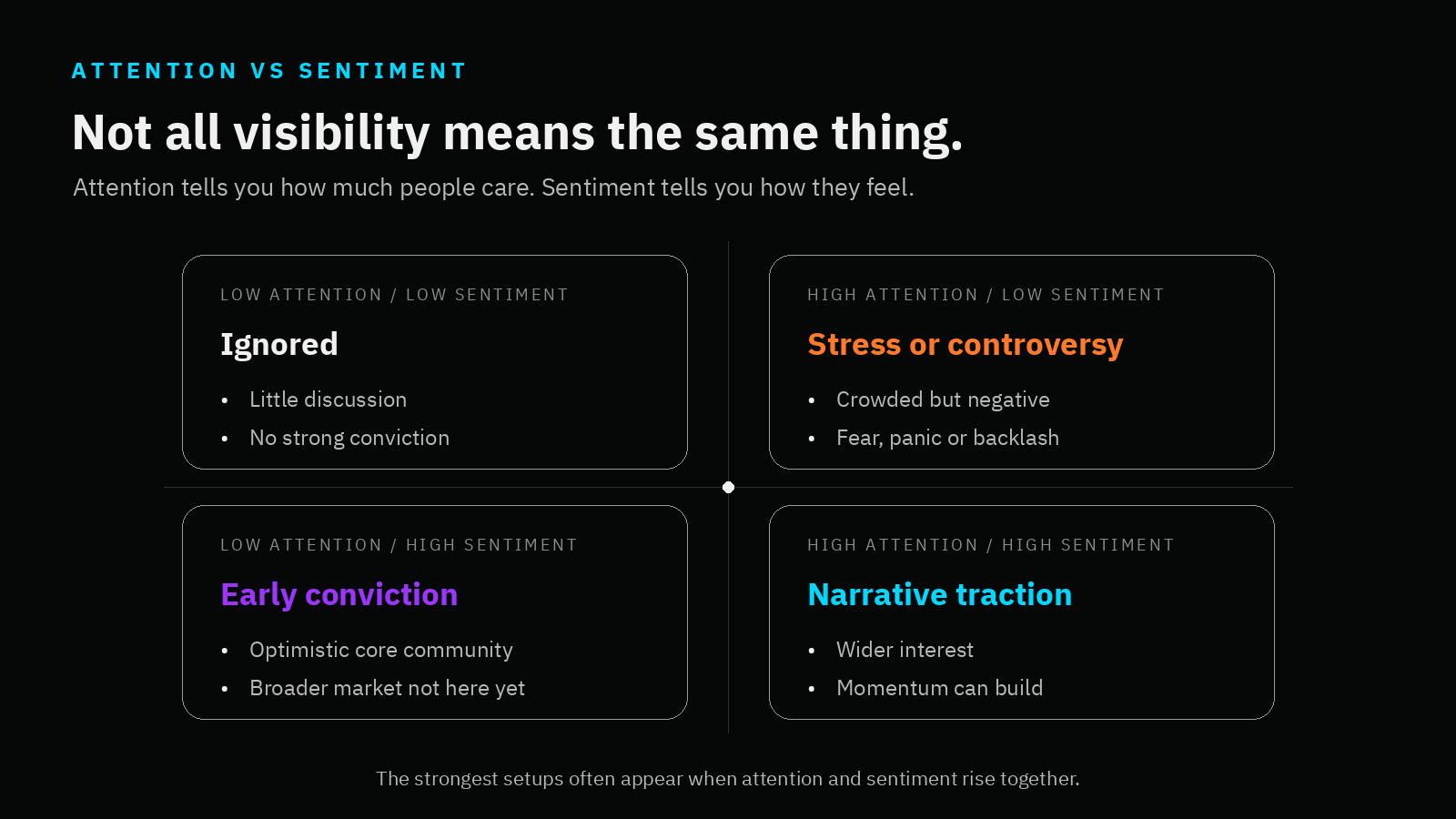
Signal 8: Attention Versus Sentiment
Attention and sentiment are related, but they are not the same.
Attention tells traders how much people are talking.
Sentiment tells traders how people feel.
A token can have high attention and negative sentiment. That may happen during hacks, lawsuits, crashes or controversy.
A token can have positive sentiment but low attention. That may mean the community is optimistic, but the broader market has not noticed yet.
The strongest signals often appear when attention and sentiment rise together.
Examples:
- More people are talking about the asset
- The tone is becoming more positive
- Discussion is spreading across platforms
- Market participation is also increasing
That combination can suggest that a narrative is gaining traction.
Signal 9: Risk and Manipulation Signals
Crypto markets are full of noise.
Some attention is real. Some is artificial.
Traders should track risk signals that may indicate manipulation, coordinated promotion or low-quality activity.
Risk signals include:
- Sudden repetitive posting
- Bot-like accounts
- Identical comments
- Low-quality engagement
- Suspicious influencer campaigns
- Unnatural spikes in social activity
- Extreme hype without substance
- Volume that does not match attention
- Price movement without liquidity
- Communities that ban normal questions
- Lack of transparency around catalysts
Risk analysis is important because fake hype can look like early momentum.
The goal is not to avoid every risky asset. The goal is to understand whether the signal is credible.
Signal 10: Narrative Momentum
Narrative momentum shows whether an asset is becoming part of a larger market story.
A token may move because of its own news. But it may become more powerful if it belongs to a broader theme.
Examples of narrative categories include:
- AI
- AI agents
- RWA
- DePIN
- Gaming
- DeFi
- Stablecoins
- Restaking
- L2 ecosystems
- Perpetual trading
- Memecoins
- Privacy
- Data infrastructure
Traders should ask:
- Is the asset connected to a larger theme?
- Is that theme gaining attention?
- Are similar assets moving?
- Is the market rotating into the category?
- Is the project a leader or a laggard in the theme?
- Is the narrative real or forced?
Narrative momentum can help explain why multiple assets move together.
Signal 11: Relative Strength
Relative strength shows whether an asset is outperforming comparable assets.
This matters because traders often rotate capital into the strongest names within a theme.
For example, if AI-related crypto assets are moving, traders may compare which token is leading the group.
Relative strength can be tracked by asking:
- Is this asset outperforming Bitcoin?
- Is it outperforming Ethereum?
- Is it outperforming similar tokens?
- Does it recover faster after pullbacks?
- Does it hold support better than peers?
- Does it attract more attention than competitors?
Strong relative performance can indicate that the market is choosing a leader.
Signal 12: Catalyst Quality
A catalyst is an event or development that changes market expectations.
Common crypto catalysts include:
- Mainnet launches
- Token listings
- Product releases
- Partnerships
- Governance votes
- Airdrops
- Token burns
- Protocol upgrades
- Ecosystem incentives
- Regulatory news
- Revenue updates
- New integrations
Not every catalyst is equally important.
Traders should ask:
- Is the catalyst confirmed?
- Is it already priced in?
- Does it affect real usage?
- Does it improve the project’s position?
- Is the market reacting positively?
- Is the catalyst strong enough to attract new attention?
A good catalyst can create attention. A great catalyst can strengthen a narrative.
Signal 13: Holder Behavior
Holder behavior can help traders understand conviction.
While it is not always easy to interpret, it can provide useful context.
Traders may look at:
- Long-term holder retention
- Whale accumulation or distribution
- Exchange inflows and outflows
- Wallet activity
- Token concentration
- Selling pressure after unlocks
- New holder growth
- Whether holders stay active during drawdowns
Holder behavior should not be used alone, but it can help confirm or challenge the market story.
For example, rising sentiment with heavy distribution may be a warning sign.
Signal 14: Derivatives Data
For assets with active derivatives markets, traders may also track futures and perpetuals.
Useful derivatives signals include:
- Open interest
- Funding rates
- Long and short positioning
- Liquidation clusters
- Basis
- Leverage buildup
- Sudden changes in positioning
Derivatives can reveal whether a move is spot-driven or leverage-driven.
A rally supported mainly by excessive leverage may be more fragile. A move supported by spot demand and healthy derivatives positioning may be more durable.
A Simple Framework: Price Plus Context
Traders can think of crypto analysis as a layered framework.
Layer 1: Price
What is the asset doing?
- Uptrend
- Downtrend
- Range
- Breakout
- Breakdown
- Reversal
Layer 2: Market Participation
Is the move supported by real activity?
- Volume
- Liquidity
- Market depth
- Trading participation
- Relative strength
Layer 3: Social Intelligence
Is attention growing?
- Mentions
- Community activity
- Cross-platform discussion
- Search interest
- Influencer coverage
Layer 4: Sentiment
How does the crowd feel?
- Optimistic
- Fearful
- Confident
- Uncertain
- Euphoric
- Skeptical
Layer 5: Risk
Can the signal be trusted?
- Bot activity
- Spam
- Fake engagement
- Manipulation signs
- Weak liquidity
- Low-quality hype
Layer 6: Narrative
Does the asset fit a larger market story?
- Category momentum
- Peer performance
- Catalyst strength
- Narrative fit
- Leadership within theme
The best trades usually have more than one layer supporting the idea.
Where Nodiens Fits Into Beyond-Price Analysis
Nodiens is useful because it focuses on the signals that price alone does not show.
A trader looking beyond price may need to understand:
- Is the community strong or weak?
- Is sentiment improving or fading?
- Is attention rising unusually fast?
- Is the activity organic or suspicious?
- Is market movement supported by real participation?
- Is the asset gaining narrative momentum?
Nodiens Indices are designed to help structure these questions across community and market intelligence signals. This includes community strength, sentiment strength, attention spikes, community health or risk, sentiment intelligence and market intelligence.
This type of framework can help traders avoid reacting only to price and instead evaluate the quality of the move.
Common Mistakes Traders Make When Tracking Only Price
Mistake 1: Buying every breakout
A breakout without volume, liquidity or attention may fail quickly.
Mistake 2: Ignoring sentiment
A chart can look strong while sentiment is deteriorating. That can be an early warning sign.
Mistake 3: Confusing hype with demand
Social activity does not always mean real market demand.
Mistake 4: Missing early attention
Some opportunities begin with attention and sentiment before price fully reacts.
Mistake 5: Ignoring risk signals
Fake engagement, bot activity and thin liquidity can make a move look stronger than it really is.
Mistake 6: Treating all volume as equal
Volume quality matters. Sustained multi-venue participation is more meaningful than a short spike in one place.
A Trader’s Checklist Beyond Price
Before entering a trade, consider asking:
- Is price moving with volume?
- Is liquidity strong enough?
- Is attention increasing?
- Is sentiment improving?
- Is the community active and credible?
- Is the asset part of a growing narrative?
- Are similar assets also moving?
- Is there a real catalyst?
- Are there signs of fake hype?
- Is the move supported by broad participation?
- Is the risk-reward still attractive?
- Am I early, on time or late?
This checklist helps traders move from reaction to structured analysis.
Key Takeaways
- Price shows what happened, but not always why it happened.
- Traders should track volume, liquidity, participation, attention, sentiment, community strength and risk.
- Social attention can move before price.
- Sentiment helps reveal crowd conviction.
- Community quality helps separate real interest from temporary hype.
- Market confirmation shows whether capital supports the story.
- Risk signals help traders avoid manipulated or low-quality setups.
- The strongest trading signals usually appear when price, sentiment, attention and market participation align.
FAQ
Why should traders track more than price?
Price is only the final result of market activity. Traders need context to understand whether a move is supported by volume, liquidity, attention, sentiment and real participation.
What is the most important signal beyond price?
There is no single best signal. Volume, liquidity, sentiment, attention and market confirmation are all important. The strongest setups usually combine several signals.
Is crypto sentiment analysis useful?
Yes. Sentiment analysis can help traders understand whether crowd conviction is rising, fading or becoming extreme. It is most useful when combined with market data.
How can traders detect fake hype?
Traders can look for repetitive posts, suspicious accounts, unnatural engagement spikes, weak liquidity and social activity that is not confirmed by market participation.
What is market confirmation?
Market confirmation means that price movement is supported by real trading activity, such as volume, liquidity, participation and relative strength.
What should traders track before buying a crypto asset?
Traders should track price action, volume, liquidity, sentiment, attention, community strength, narrative fit, catalysts, risk signals and market participation.
Can attention predict price movement?
Attention does not guarantee price movement, but rising attention can be an early signal that traders are beginning to care about an asset or narrative.