The Open Market Era
Markets are changing faster than the tools used to read them.
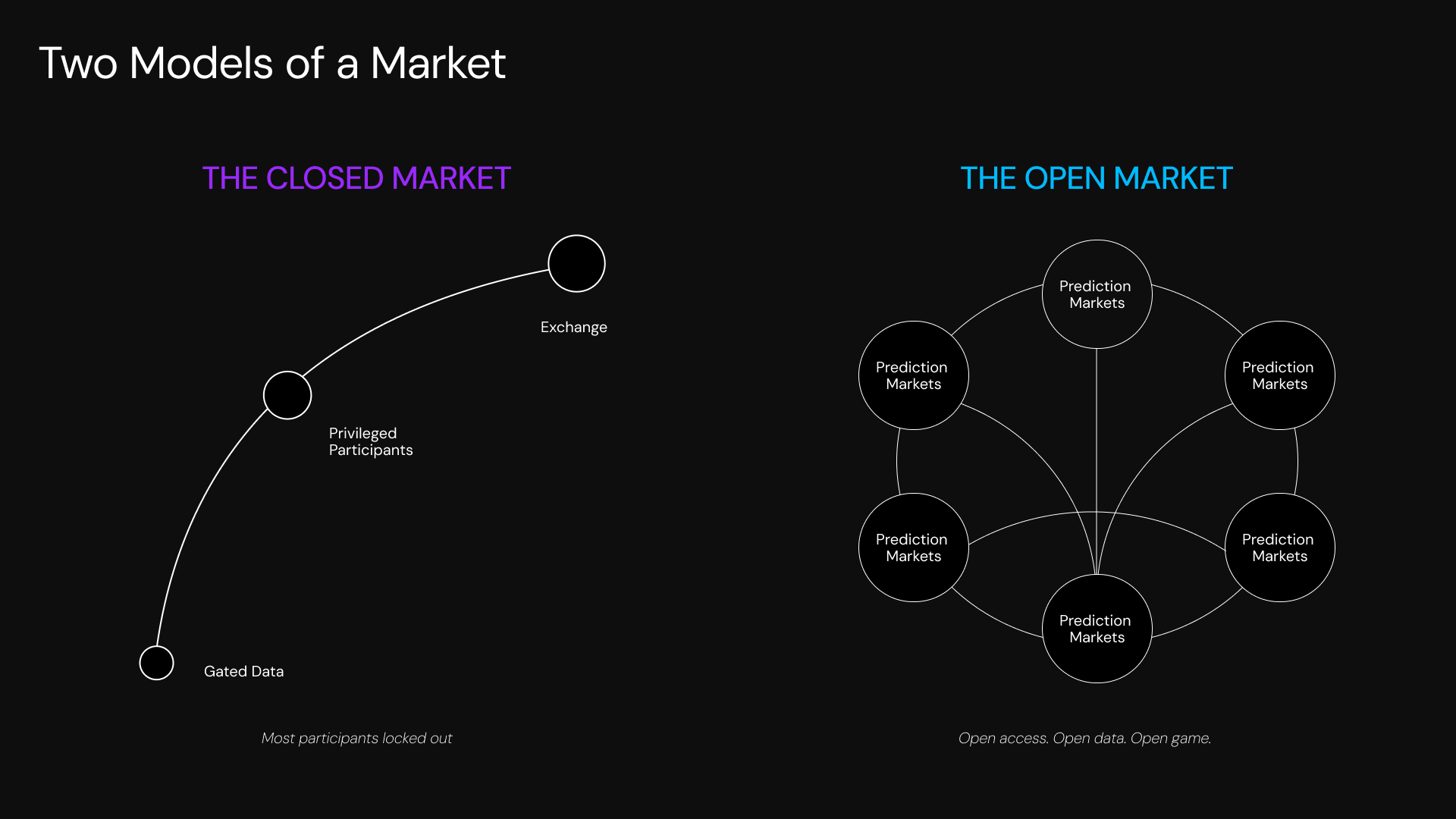
A decade ago, trading was a closed game. Order books lived inside exchanges. Position data lived inside brokers. Sentiment lived inside Bloomberg terminals and the private chat groups of people who could afford them. The edge was accessed, and access was gated.
That world is ending. Not because regulators forced it to end, but because a new generation of markets has been built on rails that are open by default. Hyperliquid exposes every perp position on a public chain. Polymarket settles every prediction trade on-chain in real time. Pump.fun watches every memecoin launch from inception. Even on centralized venues, funding rates, open interest, and liquidation data now stream publicly in near real time.
The result is a market structure in which the data that used to cost millions of dollars to access is now sitting in plain sight, available to anyone who knows how to read it.
The problem is that almost no one knows how to read it.
What Actually Changed
The shift is not just that markets moved on-chain. It is that the relationship between data and edge has inverted.
In the old market, the edge belonged to the participant with the most information. Hedge funds paid for Bloomberg terminals, satellite imagery, and credit card data because those data feeds gave them a window the retail trader did not have. The trader on Reddit was disadvantaged by definition. There was a wall between the people who saw the market clearly and the people who only saw the candle.
In the new market, the wall is gone. Every Hyperliquid position is visible. Every Polymarket bet is on-chain. On centralized venues, funding, open interest, and liquidation flow are exposed through public feeds. Every wallet's activity, every transaction, every accumulation, every distribution is observable in real time by any participant. The retail trader on X has, in raw terms, more market information than a Tiger Cub analyst had in 2010.
This sounds like a leveling. It is not. It is a reshuffle. The new edge is not access to information. The new edge is the ability to synthesize it.
A modern crypto trader can, in principle, read the on-chain positioning of every counterparty on Hyperliquid, the open interest distribution of every Polymarket question, the funding and liquidation flow across centralized exchanges, the wallet behavior of every major holder of every major token, the sentiment trajectory of every major narrative on X, and the cross-flow between these venues. In principle. In practice, no human being can do this. The data is too fragmented, too voluminous, and too noisy.
The participant who wins in this market is not the one with privileged access. There is no privileged access. The winner is the participant whose intelligence layer compresses the chaos into something decision-ready.
New Venues, New Logic
Look at where the most-watched markets in crypto have moved over the last twelve months.
Hyperliquid has become the dominant on-chain perp venue, with daily volumes that rival CEXs and a transparency model no centralized exchange can match. The centralized venues have not gone away, though, and the funding, open interest, and liquidation signals they publish remain core inputs the same trader has to read alongside it. Polymarket has crossed from a niche prediction venue into a mainstream signal layer that financial press now cites alongside polling data. Decentralized memecoin launchpads have demonstrated that for an entire category of assets, the lifecycle from creation to peak to death happens in days and is driven by signals invisible to traditional charting tools.
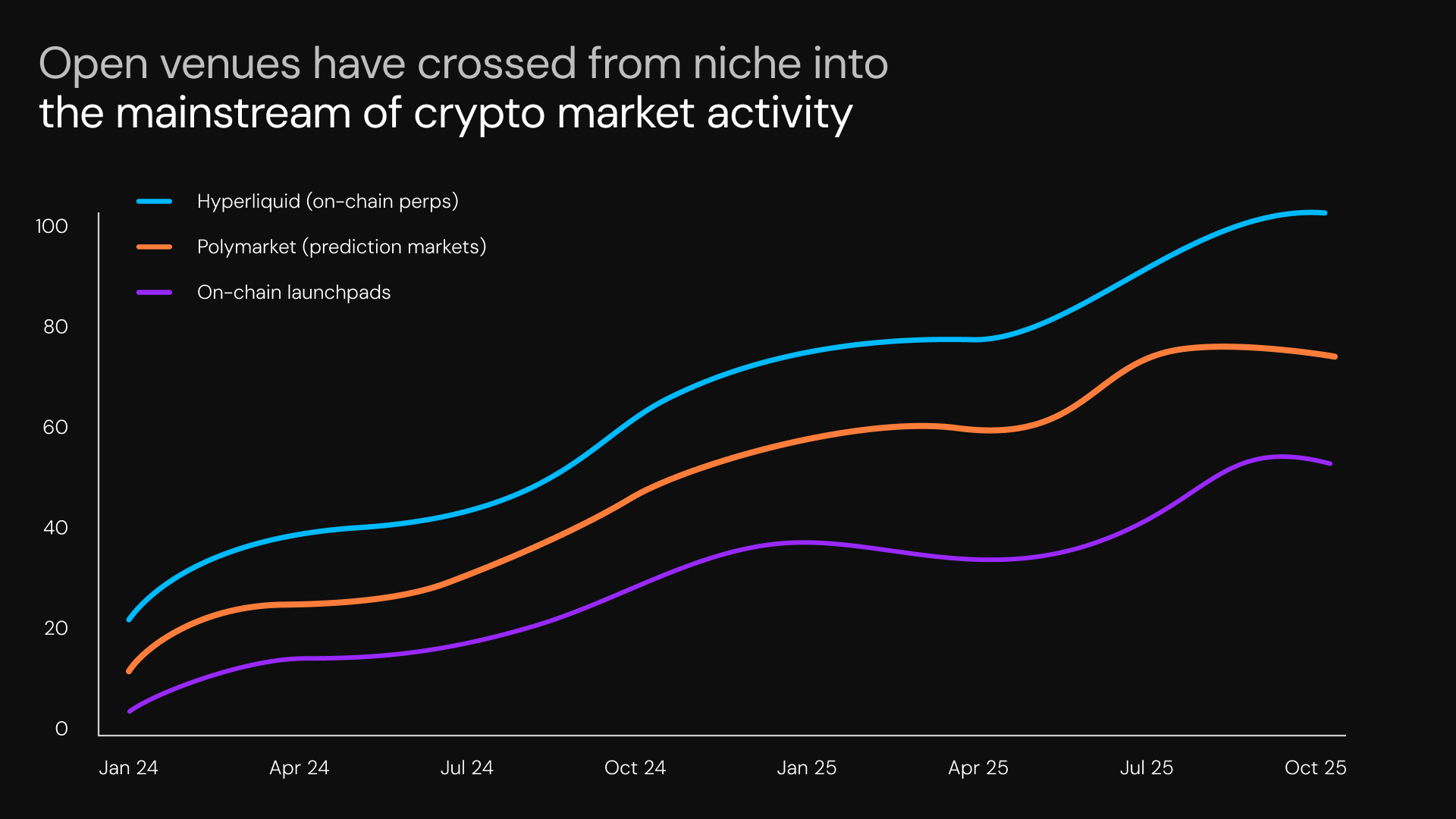
These venues do not just represent migration from one set of exchanges to another. They represent a new logic about what a market is.
A traditional market is a price discovery mechanism with limited information leakage. Most of what happens inside it is opaque to outside observers, by design. The new venues invert that. They are price discovery mechanisms with maximum information leakage. The system is built to be observable. The intent is for any participant to be able to see what is happening, in real time, at the same fidelity as any other participant.
This has consequences. Some are immediately obvious. A market in which every position is visible is a market in which crowded trades are visible too. A market in which every whale wallet can be tracked is a market in which accumulation patterns can be anticipated. A market in which every prediction is on-chain is a market in which probability shifts before mainstream media reports them.
Other consequences are less obvious. The big one is that on-chain data alone has stopped being enough.
The Stream Problem
On-chain data tells you what wallets did. It does not tell you why they did it, what they are going to do next, or what the broader pool of attention thinks about what they did. To answer those questions, you need a second stream: the social layer.
Social data has always been part of crypto, but for most of the asset class’s history it has been treated as noise. Bots, manipulation, paid posts, recycled threads, and coordinated narratives have made raw social feeds nearly unusable for serious decision-making. The signal was buried under so much pollution that most professional traders learned to filter it out entirely.
That choice was correct when the social layer was unfilterable. It is no longer correct. Cleaned, deduplicated, manipulation-resistant social data is now a tractable engineering problem, and the institutions that solve it are unlocking the second half of the picture that on-chain data leaves incomplete.
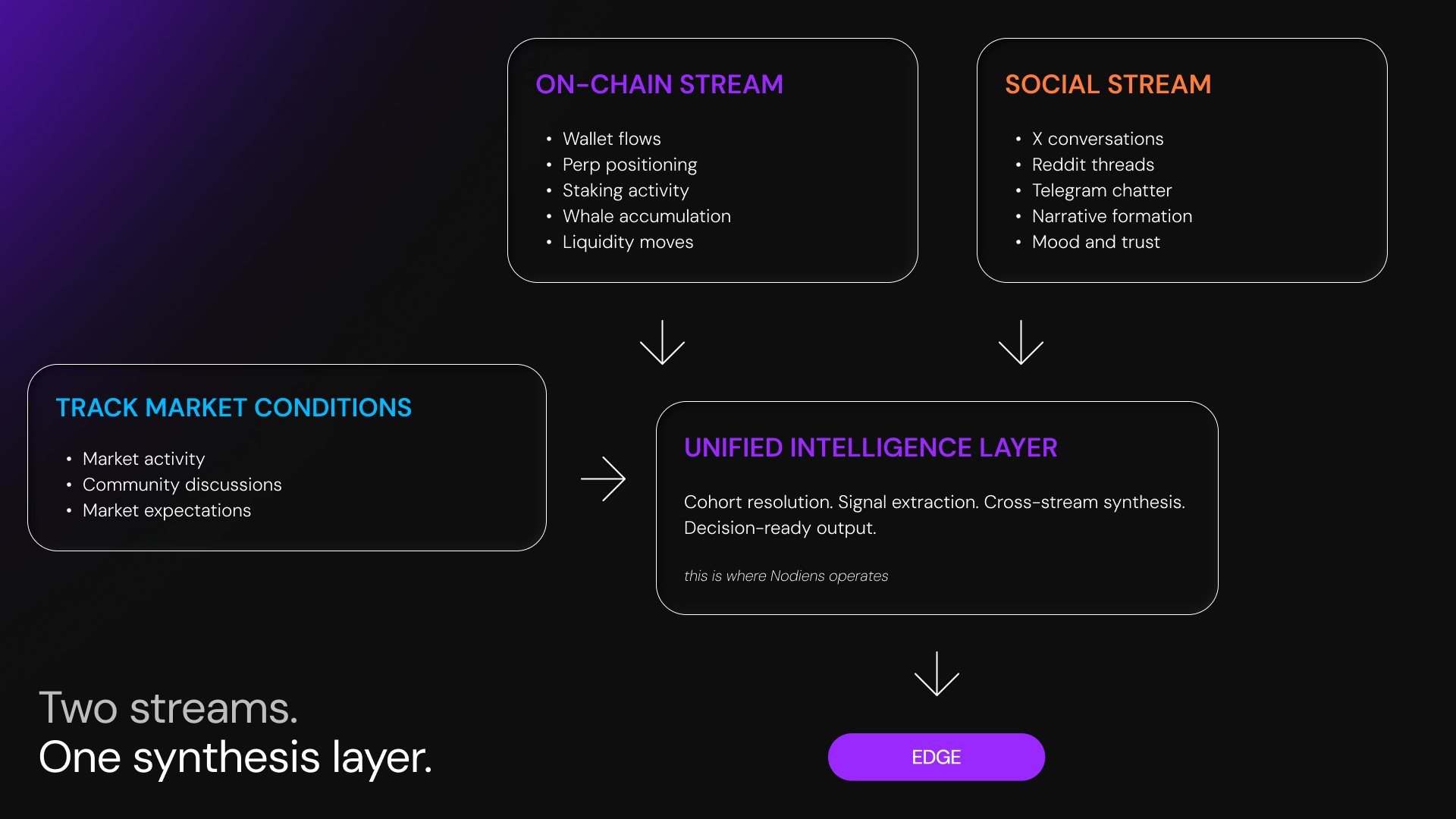
The asymmetry is striking. A trader looking only at on-chain data sees the action without the context. A trader looking only at social data sees the chatter without consequence. A trader looking at both, in a unified stream, sees what the market is doing AND what the market is thinking about what it is doing. That second-order view is where edge now lives.
This is the thesis that Nodiens is built around, and it is the thesis that we at Surgence have watched play out across more than a hundred protocol engagements. The teams that understand this integration are pulling away from the teams that do not. The traders who internalize it are compounding faster than the traders who treat sentiment as garnish.
Why Each Stream Alone Fails
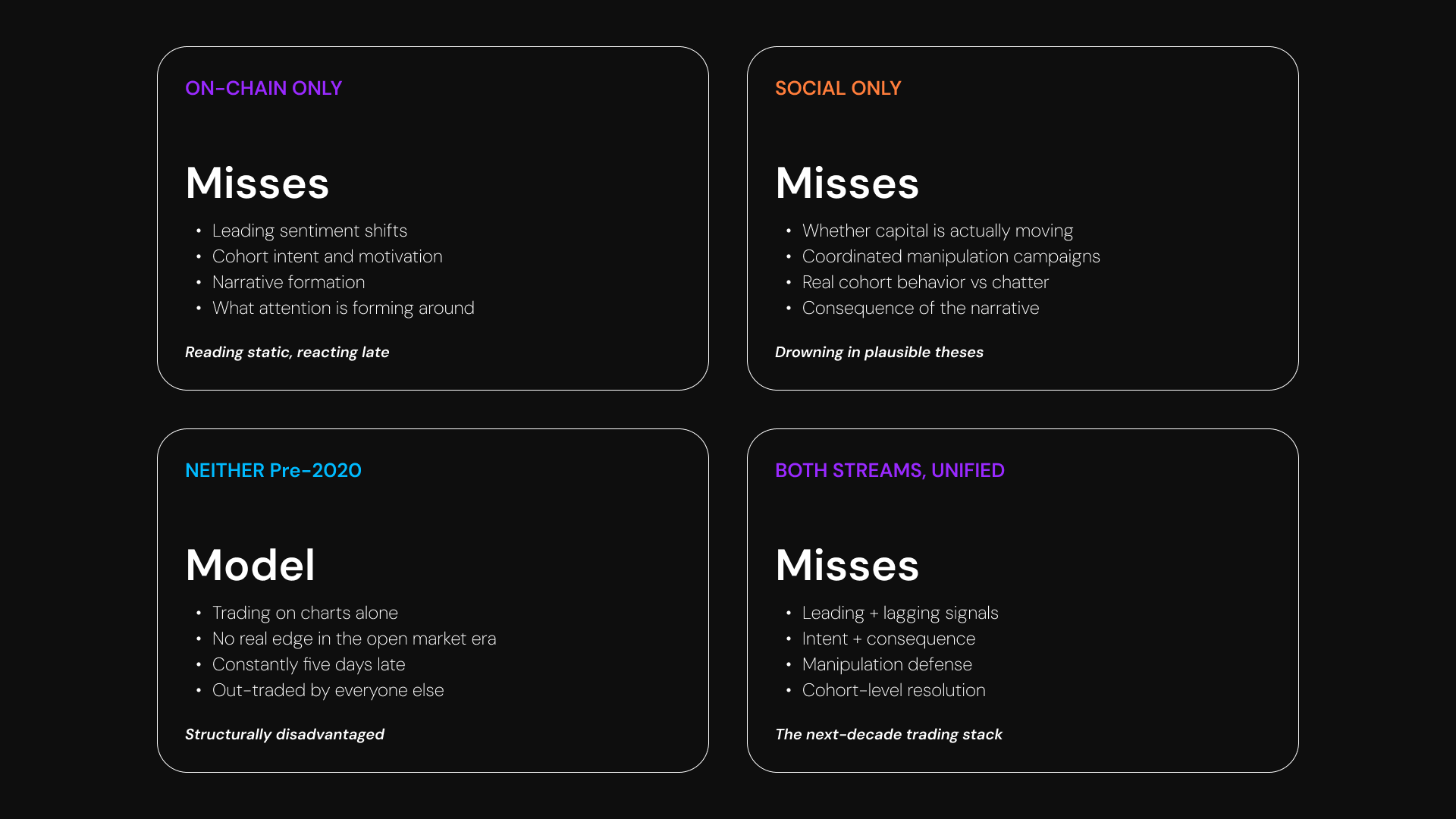
Consider what each data layer misses when read in isolation. By market behavior we mean the combined picture of on-chain positioning and centralized exchange flow. By social we mean the sentiment layer."
On-chain data without social data misses leading signals.
A wallet’s accumulation pattern only becomes meaningful if you can correlate it to a broader shift in attention. Otherwise you are reading static. By the time the on-chain accumulation was large enough to move price, the social layer was already trending in that direction. The trader with sentiment context saw it coming. The trader with only on-chain data is reacting.
On-chain data without social data misses cohort intent.
A whale buying could be conviction or could be hedging an off-chain short. A wallet distribution could be panic, profit-taking, or rotation. Social signals disambiguate intent in a way that flow data alone cannot. Without it, the on-chain analyst is reading the right book in the wrong language.
Social data without on-chain data misses consequence.
Crypto Twitter generates more bullish narratives in a week than the market can possibly absorb. Sentiment by itself is a list of stories, most of which will never matter. On-chain data tells you which stories have started to move actual capital. Without the on-chain layer, the social analyst is drowning in plausible-sounding theses with no way to rank them.
Social data without on-chain data misses manipulation.
Most sophisticated manipulation campaigns now operate through social engineering. Coordinated posting, narrative seeding, bot amplification. Without on-chain corroboration, sentiment looks real even when it has been manufactured. The combination of cleaned social filtering and on-chain flow verification is the only reliable defense against this kind of attack on a trader’s information set.
Neither stream is sufficient. The integration is the product.
The New Trader
The trader who succeeds in the open market era looks different from the trader who succeeded in the cycle before.
She does not stare at candles all day. She watches the relationship between sentiment, flow, and positioning across multiple venues at once. She knows which whale wallets matter and which narratives have started to attract real capital versus which ones are noise. She can read a Polymarket order book the way an older trader read commodity futures. She treats Hyperliquid open interest as a sentiment indicator in its own right. She understands that funding rates and Mood Indices and prediction market odds and on-chain accumulation are different views of the same underlying object.
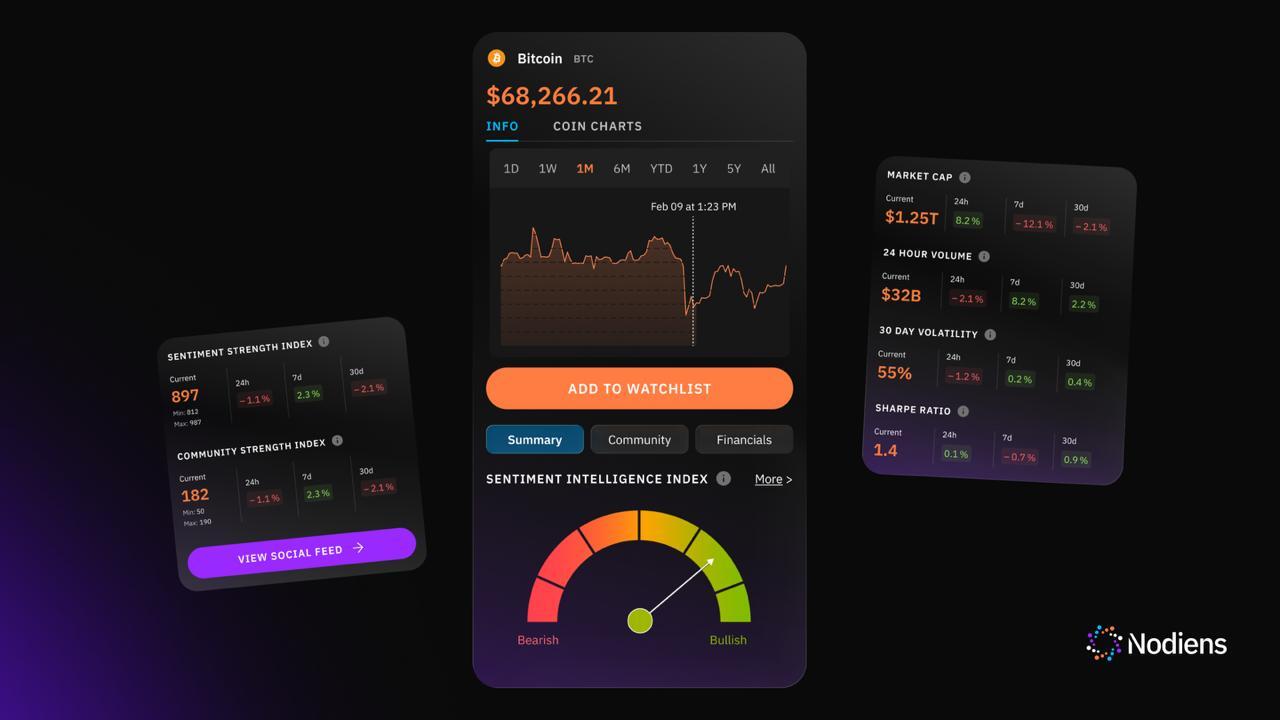
This trader does not have more time than the previous generation. She does not have a bigger team. What she has is an intelligence layer that compresses the new abundance of data into something her brain can actually use. Without that layer, the open market era is a firehose. With it, the firehose becomes signal.
The tooling has lagged the market structure. Most of the platforms a trader uses today were built for a world in which on-chain data and social data and sentiment data and price data sat in separate silos. The next generation of platforms is being built for a world in which they sit in one place. The trader who insists on integrating these streams manually, by switching between four tools and trying to hold the picture in her head, is making the same mistake that pre-Bloomberg traders made by trying to hold market depth in their heads. It does not scale, and the participants who refuse to upgrade their tools will get out-traded by the ones who do.
What This Means for the Next Cycle
The open market era is going to be louder, faster, and more reflexive than anything crypto has seen before. The reason is structural. When markets are radically transparent, every participant can see what every other participant is doing, and the feedback loops between attention, flow, and price compress dramatically. A narrative that would have taken six weeks to play out in 2021 now plays out in six days. The half-life of every alpha shrinks because the dissemination of information accelerates.
The implication is not that the edge has disappeared. It is that the surface area on which the edge exists has shifted. It used to live in access. Now it lives in synthesis. The traders, funds, and institutions that build or buy a synthesis layer will compound. The ones that do not will spend the next cycle wondering why their thesis kept arriving five days late.
For the protocols building in this era, the implication is similar. Communities now form around tokens at a velocity that no traditional marketing playbook can keep up with. The teams that understand how attention, sentiment, and on-chain behavior interact will design better tokens, build better launches, and retain communities through cycles that would have killed previous generations of projects. The teams that ignore this will keep doing what worked in 2021 and keep being confused about why it does not work anymore.
This is the world Nodiens is built for, and it is the world Surgence helps protocols navigate. We are not building for the market that existed five years ago. We are building for the market that exists now, and for the one that is taking shape over the next two.
The Stack of the Next Decade
Every era of trading has produced its own canonical tooling. The previous generation got Bloomberg terminals. The trader of the open market era needs something different: an intelligence layer that resolves on-chain behavior, social sentiment, narrative attention, and market structure into a single unified view, with the kind of methodological rigor that institutions can underwrite and the kind of speed that traders can act on.
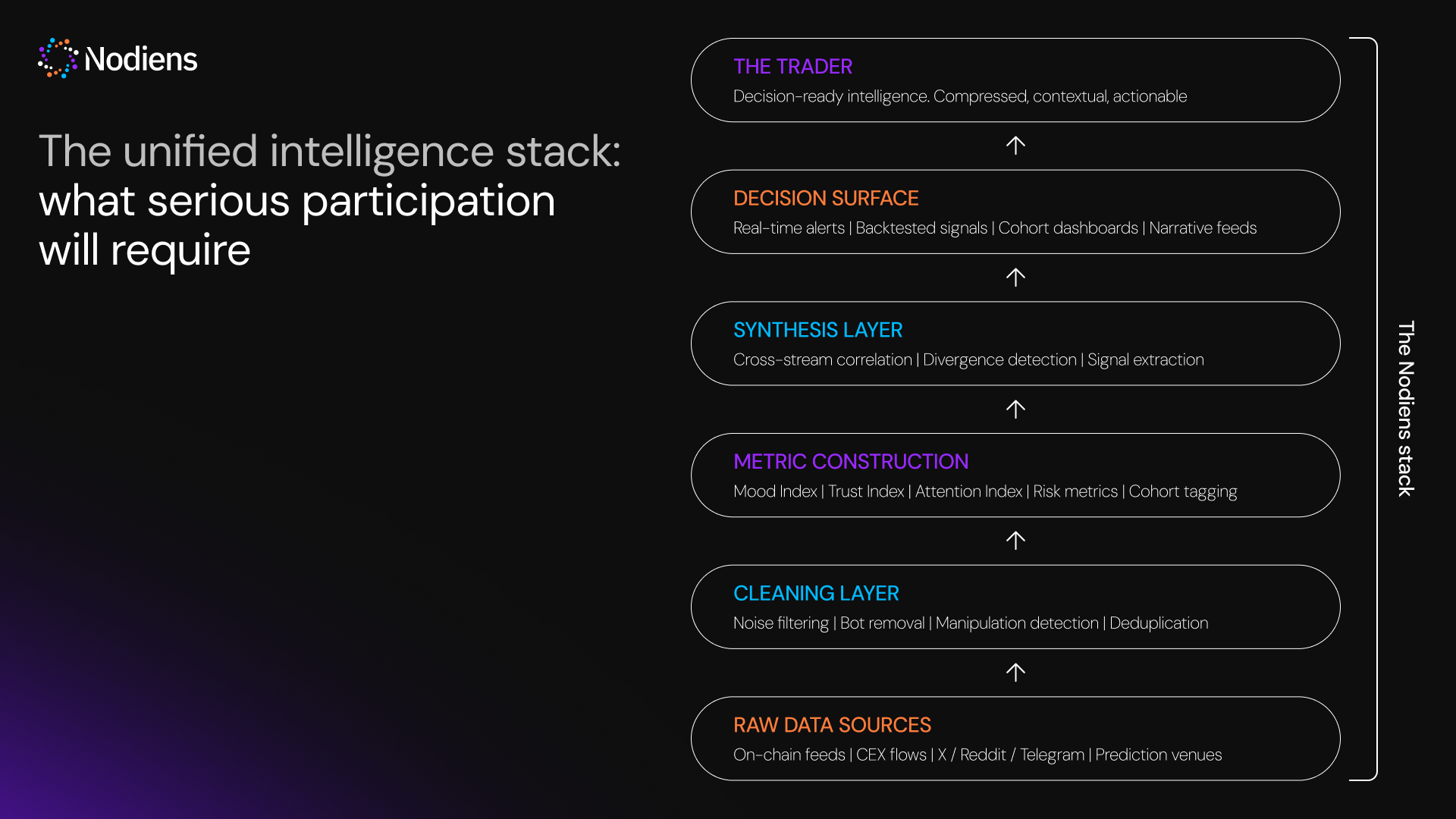
That is the stack we are betting on. A trading workspace built around cleaned social streams, methodology-backed sentiment indices, on-chain behavioral cohorts, and narrative attention measured across venues. The Nodiens platform is the first attempt we have seen at putting all of this in one place, with the data integrity that the institutional layer of crypto is going to demand as it matures.
This is not a thesis about a single tool. It is a thesis about the direction of the market. Open markets demand open data. Open data demands new synthesis. And the synthesis layer is where the next generation of traders, funds, and institutions are going to find their edge.
The participants who get there early are going to look back, three years from now, at the period we are in right now and see it the way old-school equity traders saw the arrival of the Bloomberg terminal: a step change in what a market could be read as, and a step change in what serious participation required.
What the Synthesis Looks Like in Practice
The same synthesis layer pays off differently depending on who is holding it.
For the trader, it answers the only question a trending narrative raises: is capital actually following it? When social attention, on-chain accumulation, exchange inflows, and rising open interest line up, that is a narrative worth front-running. When the story trends with no flow behind it, it is noise. And when a trade gets crowded, with funding stretched and open interest piled on one side, that is the signal to de-risk rather than chase.
For the fund, it turns raw sentiment into something a desk can underwrite. Cleaned, manipulation-resistant signal becomes a diligence layer: before sizing into a token, an analyst can check whether the community is organic or seeded, whether holders are real cohorts or wash, and whether a narrative is durable or a single coordinated push.
For the protocol, it makes community velocity legible. A team can watch attention form around a launch, separate genuine traction from bot amplification, see whether early holders are accumulating or rotating out, and read the mood of a community across a full cycle.
The market is already open. The data is already there. The only question left is whether you have the stack to read it.
This article is for informational purposes only and does not constitute financial, investment, or trading advice.
Nodiens is a unified crypto market intelligence platform that combines price data, risk metrics, fundamentals, sentiment analysis, and community signals into one workspace.
Built on a foundation of academic research originating at the UCL Centre for Blockchain Technologies and incubated for two years at Exponential Science, Nodiens processes over ten million daily data points across more than four thousand Web3 assets.
Surgence Labs is a full-stack Web3 go-to-market studio that has worked with more than a hundred protocols across DeFi, RWA, prediction markets, gaming, and infrastructure.