How to Spot Crypto Narratives Early
Introduction
NFA; DYOR
Crypto markets do not move only because of charts.
They move because people start paying attention. They move because communities get louder. They move because a new idea becomes believable. They move because traders begin repeating the same story until it turns into a market narrative. That is why spotting crypto narratives early can be one of the most valuable skills for traders.
A narrative is not just a trending word. It is a shared belief that starts influencing how people allocate attention, capital and conviction. AI tokens, memecoins, RWA, DePIN, restaking, L2s, gaming, stablecoins and agentic trading are all examples of themes that can become narratives when enough people start caring about them at the same time.
The hard part is not noticing a narrative once everyone is talking about it. The hard part is identifying when a narrative is starting to form before it becomes obvious.
This guide explains how traders can spot early crypto narratives by tracking attention, sentiment, community behavior, market confirmation and risk signals.
What Is a Crypto Narrative?
A crypto narrative is a market story that explains why a group of assets may matter.
It gives traders a reason to pay attention.
A narrative can be based on:
- A new technology trend
- A regulatory shift
- A product launch
- A token unlock or tokenomics event
- A new market category
- A major protocol upgrade
- A social trend
- A macro theme
- A meme cycle
- A change in user behavior
In simple terms, a crypto narrative answers the question: Why should this asset or category matter right now?
For example, when traders talk about AI agents in crypto, the narrative is not only “AI tokens are going up.”
The deeper narrative may be that autonomous software agents could create new demand for infrastructure, payments, data layers, compute, wallets or trading tools.
The strongest narratives usually combine three things:
- A clear story
- Growing attention
- Market confirmation
When those three line up, traders start paying attention.
Why Early Narrative Detection Matters
By the time a crypto narrative appears everywhere on X, YouTube, Telegram and market newsletters, it may already be crowded.
Early detection matters because narratives often develop in stages.
Stage 1: Weak signal
A few people start discussing a theme. Mentions are scattered. The market may not care yet.
Stage 2: Attention builds
More accounts begin referencing the same idea. Smaller communities become active. Search interest and social volume begin rising.
Stage 3: Sentiment strengthens
The tone becomes more confident. People are not just mentioning the theme, they are building conviction around it.
Stage 4: Market confirms
Related assets start moving. Volume increases. Traders begin rotating capital into the theme.
Stage 5: Mainstream attention
Everyone knows the narrative. This is often where the opportunity becomes riskier because the trade is more obvious.
The goal is not to predict every trend perfectly. The goal is to detect when a topic moves from noise to possible narrative formation.
Signal 1: Rising Attention Before Price Moves
Attention is often one of the earliest signals.
Before traders buy an asset, they usually notice it, discuss it, debate it or add it to a watchlist. That attention can show up before price fully reacts.
Early attention signals include:
- More mentions across social platforms
- Higher message activity in Telegram or Discord communities
- More Reddit threads or comments
- More X posts from niche accounts
- More search interest around a theme
- More comparison posts between similar tokens
- More “watchlist” mentions
- More questions from retail traders
The key is not just whether people are talking. The key is whether attention is rising relative to the asset’s normal baseline.
A small token going from almost no discussion to consistent discussion may be more interesting than a large token that is always mentioned.
Signal 2: Attention Spikes
An attention spike happens when discussion volume rises sharply above normal levels.
This can happen because of:
- News
- Listings
- Product launches
- Influencer attention
- Market movement
- Ecosystem announcements
- Partnerships
- Rumors
- Community campaigns
- Sudden controversy
Attention spikes are useful because they show that something changed.
But traders should be careful. A spike does not automatically mean the signal is bullish. Attention can rise because people are excited, but it can also rise because they are worried, angry or confused.
Is attention rising with positive conviction, negative concern or neutral curiosity?
That is where sentiment analysis becomes important.
Signal 3: Sentiment Shift
Sentiment tells traders how the crowd feels.
In crypto, sentiment can change quickly. A token can move from ignored to exciting in a few days. A previously popular project can lose confidence just as fast.
Traders should watch for sentiment shifts such as:
- More optimistic language
- More confident long-term claims
- Less fear around previous risks
- More users defending the project
- More excitement around upcoming catalysts
- More positive comparisons with competitors
- More questions from new users
- More organic discussion outside the core community
Sentiment is especially useful when it changes before price.
For example, if a project’s community becomes more active and more positive while price is still flat, that may indicate early conviction building.
But sentiment alone is not enough. Traders should always ask whether the sentiment is organic, persistent and supported by broader attention.
Signal 4: Community Strength
A strong crypto narrative usually needs more than short-term hype. It needs a community that can keep the story alive.
Community strength is not the same as follower count.
A project can have many followers and still have a weak community. Another project can have a smaller audience but much stronger engagement, retention and belief.
Healthy community signals include:
- Consistent discussion over time
- Real users asking thoughtful questions
- Organic replies, not only promotional posts
- Community members explaining the project to others
- Repeated engagement from long-term supporters
- High-quality conversations across multiple platforms
- Users building tools, dashboards, memes or educational content
- Discussion that continues even when price is not pumping
Weak community signals include:
- Many followers but low engagement
- Repetitive comments
- Spam-like activity
- Overuse of hype language
- Low-quality replies
- Sudden bursts of identical messaging
- Engagement that disappears when incentives stop
The best narratives are usually supported by communities that can sustain attention, not just create temporary noise.
Signal 5: Cross-Platform Diffusion
A narrative becomes more powerful when it spreads across platforms.
One Telegram group talking about a token is not enough. One influencer thread is not enough. One Reddit post is not enough.
A stronger early signal appears when the same theme begins showing up across multiple channels.
Traders should watch for mentions across:
- X
- Telegram
- Discord
- YouTube
- Farcaster
- Crypto newsletters
- Trading groups
- Research blogs
- Exchange watchlists
- Data dashboards
When a topic starts spreading from niche communities into broader trader conversations, it may be transitioning from local interest to market narrative.
This is important because narratives need distribution. If the story stays trapped inside one small community, the market impact may be limited.
Signal 6: Market Confirmation
A narrative becomes more interesting when social signals and market signals start confirming each other.
Price movement alone can be misleading. Social hype alone can also be misleading. But when attention, sentiment and market activity move together, the signal becomes stronger.
Market confirmation can include:
- Price beginning to trend
- Volume increasing
- Liquidity improving
- More active trading participation
- Breakouts from long consolidation
- Stronger relative performance versus similar assets
- Derivatives activity increasing
- Reduced selling pressure during pullbacks
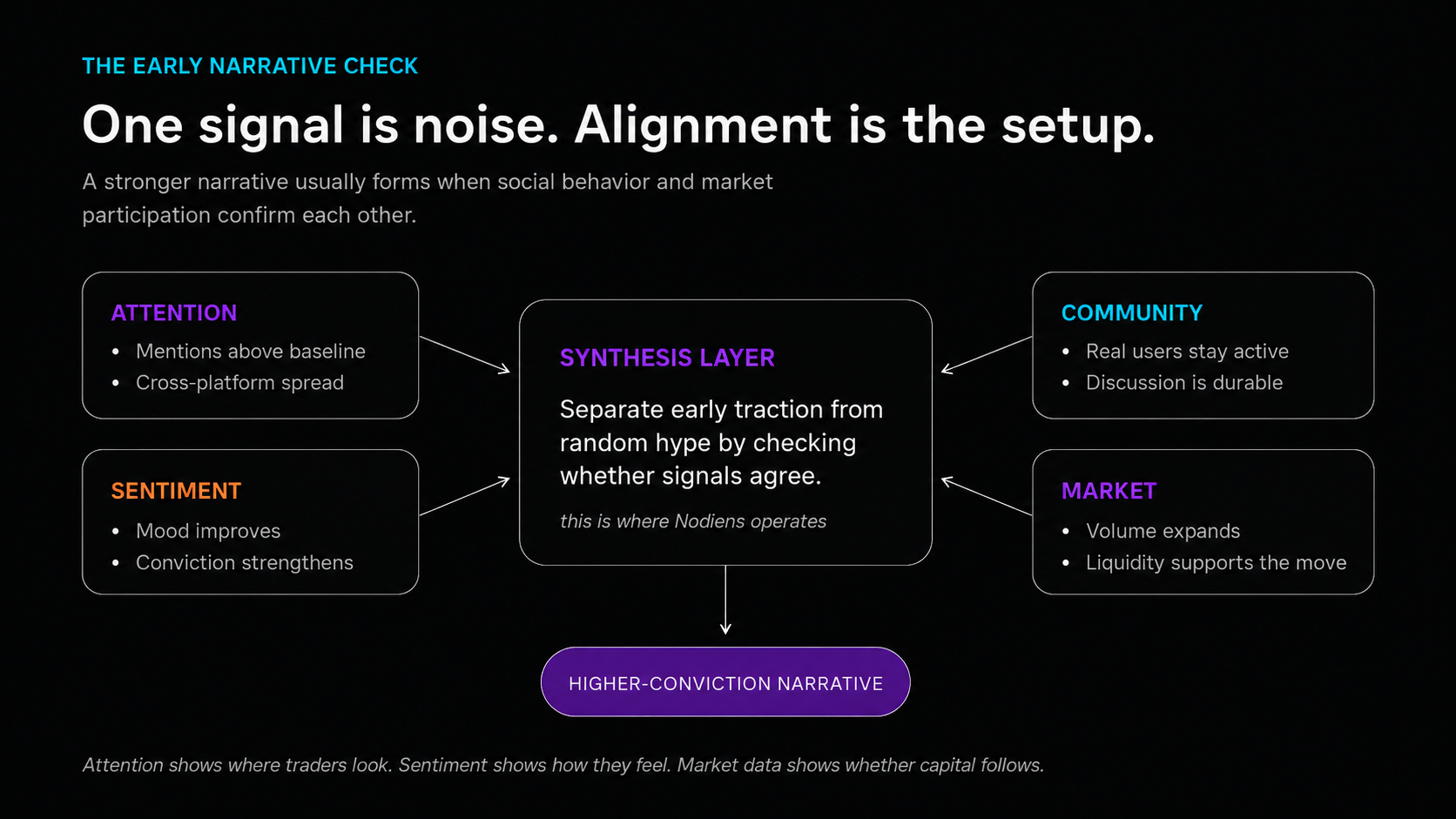
A useful framework is:
Attention shows where traders are looking.
Sentiment shows how they feel.
Market confirmation shows whether capital is actually moving.
If all three improve together, the narrative may be gaining strength.
Signal 7: Relative Strength Within a Theme
When a narrative starts forming, not every token in the category moves equally.
Some assets become leaders. Others lag behind.
For example, if the AI agent narrative is gaining traction, traders may compare AI infrastructure tokens, agent launchpads, data networks, compute projects and related ecosystems.
The goal is to identify which assets are showing the strongest combination of:
- Attention growth
- Positive sentiment
- Strong community activity
- Market participation
- Relative price strength
- Liquidity
- Lower manipulation risk
A token that leads its category early may become the main asset traders use to express that narrative.
Signal 8: Narrative Fit
Not every asset that claims to belong to a hot category actually fits the narrative.
When a theme becomes popular, many projects try to attach themselves to it. This can create confusion.
Traders should ask:
- Does the project actually solve a problem related to the narrative?
- Is the connection real or just marketing?
- Are users discussing the connection naturally?
- Does the product support the story?
- Is there real development activity?
- Is the market treating the asset as part of the theme?
- Are comparable assets moving together?
Narrative fit matters because weak or artificial connections often fade quickly.
A token can mention AI, RWA or agents in its marketing, but that does not mean the market will accept it as a real narrative asset.
Signal 9: Suspicious Activity and Fake Hype
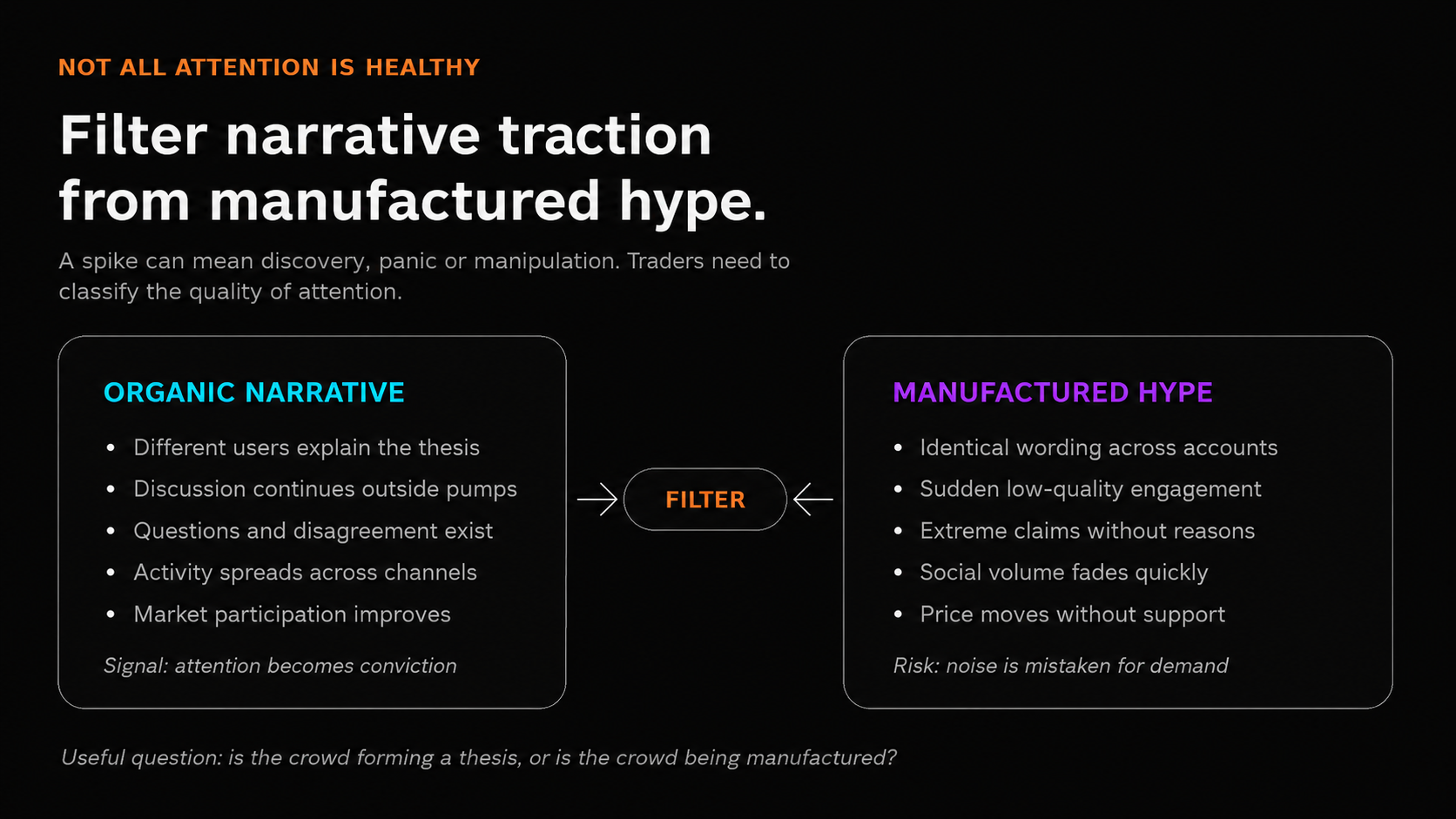
Crypto narratives can be organic, but they can also be manufactured.
Fake hype is common because attention has value. If a team or group can make a token look popular, they may attract traders who mistake artificial activity for real demand.
Risk signals include:
- Repetitive posts
- Identical wording across accounts
- Sudden unnatural engagement
- Low-quality comments
- Bot-like behavior
- Overly promotional language
- Extreme sentiment without real discussion
- New accounts pushing the same message
- Engagement spikes without market confirmation
- Social volume that disappears quickly
This is why community health matters.
A strong narrative should have real discussion, not just coordinated promotion.
A Practical Workflow for Spotting Crypto Narratives Early
Here is a simple workflow traders can use.
Step 1: Start with attention
Look for assets or themes with rising discussion volume.
Ask:
- Is this asset being mentioned more than usual?
- Is the theme appearing across more than one platform?
- Are new people entering the conversation?
- Is attention growing before price has fully moved?
Step 2: Check sentiment
Look at the tone of the conversation.
Ask:
- Are people becoming more positive?
- Is confidence increasing?
- Are concerns decreasing?
- Is the sentiment based on real reasons or just hype?
Step 3: Evaluate community strength
Check whether the community looks durable.
Ask:
- Are real users participating?
- Is engagement consistent?
- Do people explain the project clearly?
- Does discussion continue during flat or negative price action?
Step 4: Watch for risk signals
Look for manipulation or low-quality attention.
Ask:
- Are posts repetitive?
- Are accounts suspicious?
- Is engagement too sudden or unnatural?
- Is the conversation dominated by promotional language?
Step 5: Confirm with market data
Check whether the market supports the social signal.
Ask:
- Is volume increasing?
- Is liquidity improving?
- Is price showing relative strength?
- Are pullbacks being absorbed?
- Is market participation broadening?
Step 6: Compare assets in the same narrative
Do not look at one token in isolation.
Ask:
- Which asset is leading the category?
- Which has the strongest community?
- Which has the cleanest sentiment?
- Which has the strongest market confirmation?
- Which has the lowest risk of artificial hype?
Where Nodiens Fits Into Narrative Detection
Nodiens can support this workflow by helping traders organize fragmented crypto signals into clearer intelligence.
Instead of only looking at price charts or social feeds manually, traders can use Nodiens-style indices to evaluate different parts of the narrative formation process:
- Community Strength, to assess whether a project has durable support
- Sentiment Strength, to understand the emotional tone of the crowd
- Community Health or Risk, to detect suspicious or artificial activity
- Spike Attention, to identify unusual increases in attention
- Sentiment Intelligence, to connect mood with attention intensity
- Market Intelligence, to see whether price movement is backed by real participation
This matters because early narratives are rarely obvious from one metric. They usually appear when multiple signals begin to align.
Common Mistakes Traders Make
Mistake 1: Chasing every trending token
Not every trending asset becomes a real narrative. Some are short-term pumps.
Mistake 2: Confusing mentions with conviction
A token can be mentioned often because of controversy, fear or spam. Mentions alone are not enough.
Mistake 3: Ignoring market confirmation
If social attention is rising but volume and liquidity are weak, the signal may not be strong enough.
Mistake 4: Ignoring fake engagement
Artificial hype can make a weak project look popular. Traders need to check community quality.
Mistake 5: Arriving too late
Once a narrative is obvious to everyone, risk often increases. The earlier stages are where research matters most.
Key Takeaways
- Crypto narratives usually start as weak signals before they become obvious.
- Early attention spikes can help traders identify where interest is building.
- Sentiment shows whether the crowd is gaining or losing conviction.
- Community strength helps separate durable interest from short-term noise.
- Market confirmation shows whether capital is supporting the story.
- Risk signals help traders avoid fake hype and manipulated attention.
- The best narrative signals appear when attention, sentiment, community quality and market participation align.
FAQ
What is a crypto narrative?
A crypto narrative is a market story that explains why a specific asset, sector or theme matters. Narratives influence attention, sentiment and capital flows.
How do traders find crypto narratives early?
Traders can look for rising attention, improving sentiment, stronger community activity, cross-platform discussion and early market confirmation.
Are social signals useful for crypto trading?
Yes, but they need context. Social volume alone can be misleading. Traders should also track sentiment quality, community health and market participation.
What is an attention spike in crypto?
An attention spike happens when discussion around an asset rises sharply above its normal level. It can signal growing interest, news, controversy or narrative formation.
How do you avoid fake crypto hype?
Look for suspicious patterns such as repetitive posts, bot-like accounts, sudden unnatural engagement, low-quality comments and weak market confirmation.
What is the best way to confirm a crypto narrative?
A narrative becomes stronger when attention, sentiment, community strength and market data all improve together.